
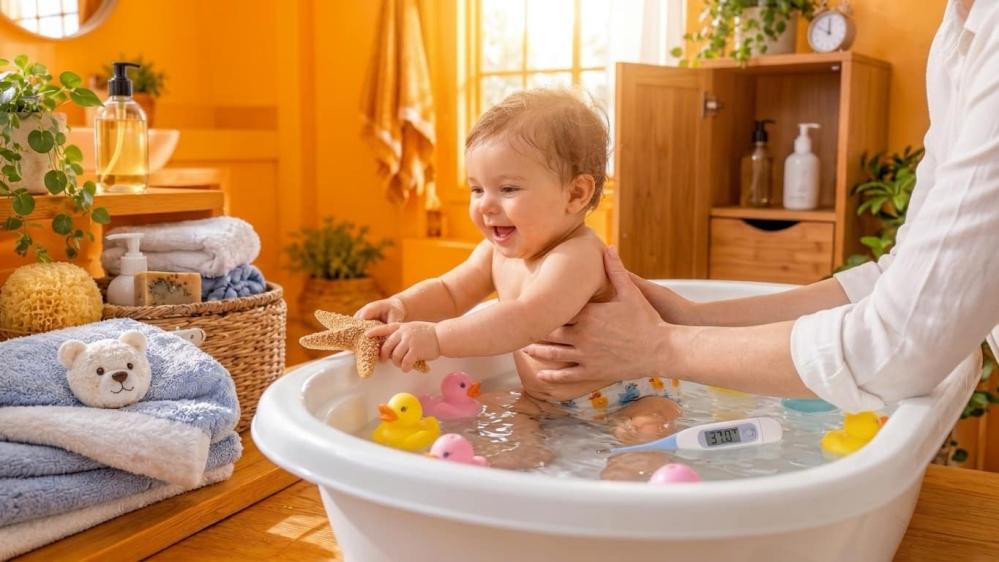
Your palm misleads you and your elbow tells the truth. The temperature is half the answer; duration and room warmth toge...
Dip your elbow in the water before you dip your child, because the skin there is thinner than your palm and less used to heat, so it reads the water closer to the way a newborn's skin does. Your palm misleads you, since it meets hot water in the kitchen daily and will tell you the bath is mild when it is in fact warmer than it should be.
New parents looked up baby bath water temperature in their first week, then discovered the number is only half the answer, with the other half sitting in how long he stays and how warm the room he steps out into happens to be.
The Number Parents Are Looking For
A newborn sits comfortably in water close to his own body heat, which lands between thirty-seven and thirty-eight degrees Celsius. The figure drops slightly after six months, when thirty-six becomes perfectly acceptable, because a child that age moves in the water and generates his own warmth.
A floating thermometer gives you the number in two seconds, and it is the simplest addition to a bath set and the most used item in the early months. Ask about one alongside whatever you order from what goes into the tub, since it goes into the tub with the pieces themselves.
Do not rely on a figure printed on the tap mixer, since that reads the temperature leaving the pipe rather than what has settled in the tub a minute later.
How to Judge It Without a Thermometer
Use your elbow if no thermometer is within reach, and hold it under for a full ten seconds before you judge. The right water reads as a faint warmth on the elbow, and whatever feels hot there is hotter than your child needs.
Always stir the water with your palm before you judge it, because heat stays at the top and cold settles below, so the surface hands you a figure that does not represent what is under your hand. Check again if you have left the tub for two minutes, since a shallow bath cools faster than most parents expect.
How Long a Bath Should Last at Each Age
Five minutes is enough in the first month, long enough to wash a newborn without letting him chill or his skin dry out. That stretches to ten minutes between three and six months, then to a quarter of an hour once your child sits unaided and starts playing in the water.
Do not measure by the clock alone, because the signs at the end of this article are more reliable than it is. Past two the bath runs to twenty minutes on account of play, and alongside it begins what works outside the water in arts and crafts start to earn their keep.
How Many Times a Week
A newborn in his first month needs three baths a week, since he does not sweat enough to justify a daily one. Between those, a damp cloth covers the face, the neck and the nappy area.
The rate then rises with movement, so a crawling child needs something close to a daily bath. A covered floor gives him a cleaner surface than bare tile, and you will find it in play rugs.
Room Temperature, Not Just Water Temperature
A great many newborns cry in the bath because of cold air rather than the water, and this is the point parents most often miss in the first month. Turn the bathroom air conditioning off or ease it down before you begin, and keep that room somewhere near twenty-four degrees. Close its door as well so no draught reaches a wet child, because the difference between bathroom air and hallway air is enough on its own to start the crying.
Winter and Summer: What Changes
Shorten the bath in winter instead of raising the water temperature, since hotter water dries a newborn's skin and leaves him more unsettled once he is out. Warm the towel and clothes near a heat source before you start, because one warm item solves half of winter.
In summer the frequency rises while the length holds, as a child sweats more and needs a quicker wash more often. Keep summer water nearer thirty-six degrees for a child past six months, because one coming in from the heat finds thirty-seven too warm against his skin.
What We Keep Within Reach at Baby Story
We arrange what you need on the rim of the tub in four groups: something that measures, something that washes, something that dries and something that plays. One item from each group is plenty in the early months, and you add to them as your child grows capable of more.
All four groups are arranged by age in our bath and play-time section, alongside newborn sets for anyone setting up for the first time.
Signs That Say the Time Is Up
Watch for three signs that make the clock unnecessary. Your child's fingertips wrinkle, which tells you his skin has had what it needs from the water; his lips take on a bluish tinge, which tells you warmth is dropping; and he loses interest in whatever piece was holding him, which tells you the fun has ended.
Lift him out at the first of those three rather than waiting for the rest, because coming out a minute early beats a whole evening of fretting. Set him on a prepared surface, and from there he moves to quiet play in a baby rocker or on the mat.
The Short Baby Story List: Heat and Time
We put together a short list for new parents that settles temperature and duration together: a floating thermometer, a pouring cup that measures the rinse, and a hooded towel that keeps the head warm. Those three cover measuring, rinsing and drying, and whatever your child plays with completes them.
Look at the shape of your tub before you choose a thermometer, since a floating one needs enough water to float in and a small sink basin will not give it that.


