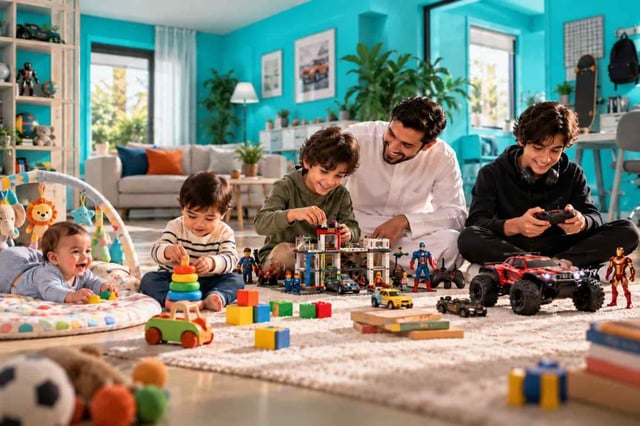

Fabric tunnels, chunky blocks, a rocker and pull-along toys for a boy past eighteen months. Why he sits beside a friend...
From the next room you hear a full conversation: a voice naming pieces, commenting, asking and answering. You walk in and find a two-year-old alone on the floor, talking to himself out loud for the past quarter hour.
Sit another child beside him and the talk barely changes. The voice stays aimed at the pieces rather than the companion. Parallel play is a known stage that closes on its own near three, but it changes what is worth buying today.
Parallel Play: Beside Him, Not With Him
A child this age watches more than he joins. He takes an idea from his neighbour, then carries it out alone. So the toys that fit are the ones that work with one player and tolerate a second without rules.
Buying something that assumes two roles at this age means a box opened once. Turn-taking starts near four and does not hurry.
What Changed in the Grip
At one he holds with the whole palm, thumb bracing. Near two a finer grip appears: thumb and index meeting on a small part. That shift is what opens assembly.
The right shelf bets on both grips at once: large pieces carried in the palm, medium ones lifted with two fingers. A shelf holding both serves him a full year.
The Tube Rule: A Safe Piece Size
The practical measure is simple. Anything that passes through a tube roughly four centimetres across leaves the house. That diameter is close to a child's throat at this age.
Look also for parts that do not break into smaller ones. A solid block stays a block when dropped. A thin hollow shell becomes fragments of a size that passes.
Push, Pull and the First Motor Pleasure
A toy dragged on a string teaches something hard to explain: that movement transfers. He walks, the piece follows, he turns to check and repeats. This kind works leg and hand together, close to what sits in the baby corner but faster and with a longer route.
Pushing is harder than pulling because it needs balance while walking. A boy who pushes a small cart steadily is ready for vehicles he sits on.
Rockers and Swings: Movement Indoors
An animal-shaped rocker solves the problem of a house with no garden. It gives forward and back motion inside a square metre and burns energy that is otherwise hard to burn between walls.
Three numbers decide the purchase: base width, seat height off the floor, and the maximum weight printed on it. A wide base will not tip, and a low seat lets him climb on alone without calling anyone.
What Survives Throwing and Chewing
Back teeth finish arriving in this stage, gums ache, and he bites what he holds. Choose smooth surfaces with no paint that lifts, rounded edges, and parts that wash in warm water and dry fast.
Toys at this age live longer with a weekly wash. Dry them in shade: direct sun makes coloured plastic brittle. The same holds for the larger pieces in the boys range.
First Assembly: Two Pieces Are Enough
Do not start with a ten-piece tower. Start with two pieces that join, and let him separate and rejoin them twenty times. Taking apart is easier than putting together and always comes first.
Then move to three pieces, then to a tower that falls. Collapse is part of the fun here and should not be treated as failure. A boy who masters this moves on to the younger shelf, where building follows written steps.
Signs He Is Moving to Three
- He names what he is building before he builds it: "car", then assembles.
- He returns pieces to the box without being asked.
- He watches another child and copies in the same moment.
Three signs together are enough. The shelf stays useful for months afterwards, so there is no need to empty it at once. Parents who prefer sorting by leaning will find browsing by interest closer to hand.
Why He Does Not Share Yet
Sharing is built, not born. At two he understands ownership before he understands exchange, and defends the piece in his hand because it has become part of his scene.
The fastest route to sharing is two identical pieces. Two boys building side by side with the same parts reach exchange by themselves. Buying in pairs at this age saves months of tug of war.