
Flexible magnetic paths, door-mounted circuits and light-up tracks from age three. How much room each type needs, and wh...
The one thing we hear most about tracks is a single sentence: we built it once, he played for two days, then we took it apart and it never came back. That is not a fault in the track but in the place it was built.
Alone among car toys, a track occupies space and stays there. Choose one on looks alone and you will find yourself dismantling it a week later so somebody can walk past.
1. Three types, three very different footprints
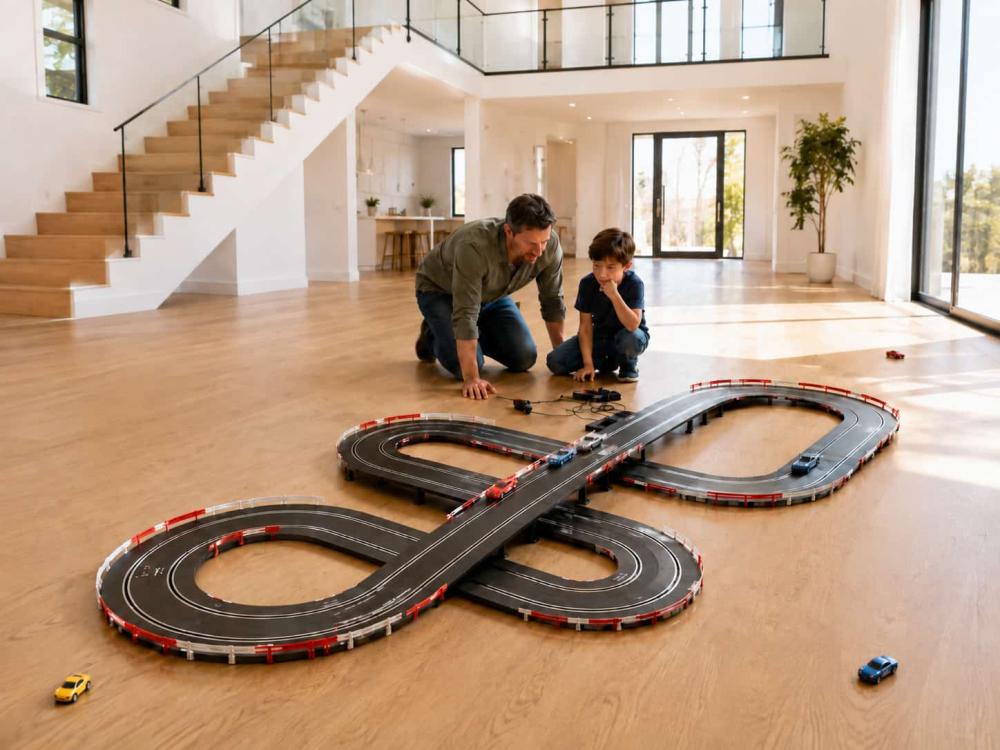
- Flat. Laid on the floor as a circle or a figure of eight. It needs permanent horizontal room, and it delights younger children most.
- Vertical. Hung on a door or wall, descending through loops and bends. It takes height and almost no floor.
- Flexible. Pieces joined by magnets or clips, so the child shapes it himself and takes it apart in minutes.
The difference is not price but house. Ask what space you actually have, then pick the type.
2. Flat: measure two metres before you buy
A laid-out track needs floor that stays clear, and clearing it at playtime is not the same thing. The child kneels around it, so add half a metre on every side.
Its best home is a corner of his own room rather than the middle of a living room, because the middle is a walkway, somebody steps on a piece, it snaps, and the enthusiasm snaps with it.
3. Vertical: the answer when there is no floor
A door-mounted track solves a small home entirely. It rises a metre and a half or more, the car descends by gravity or a launcher, and it takes no floor beyond where the child stands.
Its one condition is a door nobody uses much. A door opening every ten minutes takes the track down the same day it goes up.
4. Flexible: the track the child builds
Pieces joined by magnets or clips turn one toy into two: building, then racing. Children often spend as long building as they do playing.
This suits a child who bores quickly, because the shape changes each time and the experience never repeats. It also suits a home that cannot host anything permanent.
5. The floor beneath the track
Pieces laid on thick carpet tilt slightly, and the car leaves the lane on the bend. On polished marble the same pieces slide and the joints pull open.
The best surface for a flat track is a thin rug or a play mat: level enough to hold a line, with enough grip to stop the pieces drifting.
6. Which cars will actually run on it
Most tracks arrive with their own car, and that one is a certain fit. Adding another needs two conditions: a width that matches the lane, and a body low enough to clear the loops.
Small diecast models from the scale race cars section succeed most often, because their relative weight keeps them in lane. Large remote control cars will not fit at all, being wider than the track itself.
7. Age three to six: building beats racing
At this age a child does not care who wins. He cares that the car goes in here and comes out there, and he cares that he built it.
So choose large pieces that click together without precision, and a short circuit that completes quickly. A long circuit that never finishes only frustrates a small child.
8. Age seven and up: racing and modifying
Now something unplanned appears: the child starts modifying. He props one end on a book for more speed, tightens a bend to make it harder, and invents rules for a championship.
That is the highest value in the toy, and it peaks when he brings in a brother or a friend. This is the stage where ready-made circuits with lap counters and starting gates earn their keep.
9. Add to it rather than replace it
A track is a base to build on, not a finished toy. The first additions are new cars from the cars and vehicles shelf, then differently shaped vehicles that change the nature of play: trucks and tippers turn a race into a haul, and workshop and farm vehicles turn a circuit into a work site.
A child wanting free movement with no lane finds it in cars with remote control, and a younger sibling who wants to join gets a hand-pushed vehicle from push cars that runs beside the track rather than on it.
Before you unroll it
Pick the spot before you open the box, pace it out, and ask one question: will this still be here in a month? A track dismantled after two days did not fail in its design but in its corner.