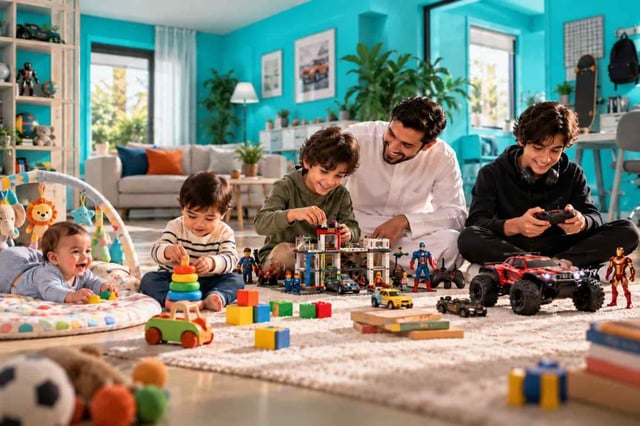

Lego Disney sets, dolls with accessories, Doorables figures and a doctor set with a trolley, for seven to nine. Wrapped...
Count once how many times your daughter returns to something you bought. You will find one piece in five gets replayed thirty times or more, while the other four are opened once or twice and then settle on a shelf.
That small count is more useful than any gift list, because it exposes a shared quality among the pieces that get replayed. And it is a quality you can spot before buying rather than after.
1. Why a build set lasts and a figure set tires
A build set gives work with a beginning and an end, then leaves something behind once the work is done. She builds, displays what she built, and takes it apart to rebuild it differently if she wants.
A figure set gives a moment of opening and then hands over a finished piece. The pleasure lives entirely in the surprise, it ends in two minutes, and it does not renew.
None of which rules figures out. They work as a small second gift or a reward, and not as the main present for an occasion.
2. Piece count against age
- Seven: a hundred to two hundred pieces. Completes in two sittings and stays inside her patience.
- Eight: two hundred to four hundred. Carries a project across two days.
- Nine: six hundred and up, taking a week across separate sittings.
A bigger number is not better. A set beyond her patience gets left half built in its box, which is worse than a smaller set that finishes.
3. The project that spans more than one sitting
The ability to leave work unfinished and return to it tomorrow appears at this age specifically. Before seven a child wants a result the same day; here she accepts a delay because she can picture the finished shape.
What helps in practice is a surface that does not get cleared every evening. A table wiped nightly kills the project, while a tray that holds the pieces and slides aside preserves it.
4. Collecting and display: an entirely new stage
She starts caring about what she owns rather than only what she plays with. She arranges figures on a shelf, knows what is missing from her set, and talks about it with friends.
Small collectable figures serve that leaning specifically, and the types are set out in collectable figures.
One practical note: give the collection a visible shelf rather than a box. A collection that disappears into a box loses half its worth to its owner.
5. Pretend play sets at this age
A doctor set with a doll and a trolley looks at first glance like a toy for someone younger, and it works here for a different reason. A seven-year-old does not act a simple role but builds a full scenario with a patient, an appointment and a follow-up.
The trolley in particular is what stretches the play, since it turns the toy from a fixed spot into something that travels around the house.
6. The gift in front of friends
At seven a child starts noticing what her friends will say about her present. That is a real consideration rather than one to dismiss, and it explains the occasional rejection of a perfectly good gift.
The rule we see working: choose something whose result can be seen. A built piece gets displayed and photographed; a wrapped piece gets opened and finished.
Leave her the final decision between two options you settled, since children accept limits that precede their choice.
7. What we ask in our branches before suggesting a gift
What does she do once she finishes a toy? A girl who displays suits build sets; one who puts the piece down and moves on suits figures.
How much time does she have daily? Half an hour means a set completing in two sittings; two hours at a weekend carries something larger.
Does she play alone or with a sister? One set between two children needs more pieces rather than fewer.
8. When to move past nine
- She finishes a four hundred piece set unaided and without a long break.
- She starts altering the design rather than following instructions exactly.
- She asks for a specific piece by name instead of requesting a toy in general.
Once two appear, the next shelf sits in the ten-plus section.
When a piece comes back thirty times
Count how often a piece gets replayed rather than how many pieces are in the box, and favour whatever remains once the work ends. Match piece count to her patience rather than her age alone, give the collection a visible shelf, and leave the surface uncleared until the project finishes.
For a girl not yet seven, see the younger girls shelf. To read her leaning before buying, see the interests map.