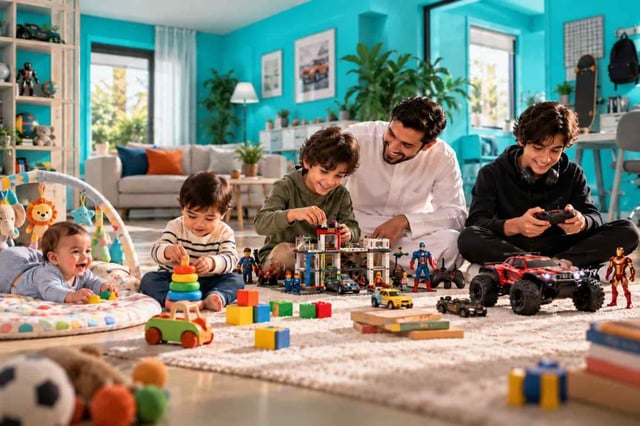

Kids motorbike toys with remote control and die-cast models to collect, from age two. Here is the difference and which s...
Toy motorbikes for children, remote controlled and models to build, from age two.
Watch your child next time they walk past a toy shelf. The small motorbike catches their eye before the car does, even though the car is bigger and more obvious.
This happens with a lot of children, and it has nothing to do with price or advertising. The reason is in the shape of the bike itself.
Why a motorbike specifically
Because it shows its rider. A car is a closed box. A motorbike is fully exposed — your child sees the rider, the handlebars, the engine and the wheels all at once, and understands how it works just by looking.
Because it leans. A bike tips into a corner; a car stays level. That lean gives a sense of motion and measured risk, which is exactly what pulls a child in.
Because it fits in their hand. Most motorbike models sit in one palm, so your child can pocket it and take it along. A large toy never builds that kind of attachment.
Because it matches what they see outside. They pass motorbikes daily and hear them. A toy that mirrors real life means more to a child than an invented one.
What these toys actually develop
Imaginative play. Your child builds a whole story around the bike: who rides it, where to, who is chasing whom. That kind of play builds language and the ability to sequence events.
Mechanical understanding. An exposed bike makes them ask how the wheel turns, why the rider leans, where the engine sits. That is the beginning of thinking about how things work.
Hand-eye coordination. With remote control toys in particular, your child steers an object moving away from them, judging distance and anticipating motion. That takes real practice.
Patience and focus. With model kits, they fit twenty pieces or more before the shape appears. Waiting for the last piece is a lesson in delayed reward that is hard to teach any other way.
Two different types: remote control and models
Remote control toys are movement and instant feedback. Your child presses and it moves, testing corners, spins and speed. Some models perform a full rotation at the push of a button.
These suit an active child who tires of sitting still, and from around two to three they start mastering the controller.
Model kits are quiet and focused. Your child builds the bike piece by piece, including LEGO sets and Maisto die-cast models detailed to mirror real machines.
These suit ages four and up, with the finer models from around seven or eight. A good fit for the child who likes things ordered and complete.
Which to choose? Watch how your child already plays. The one who takes things apart and rebuilds them will enjoy models; the one who runs and throws will enjoy remote control. Plenty of children want both at different points in the same year.
Matching the toy to the age
Two to three. Simple controllers with one or two buttons, and larger sizes that suit small hands. Avoid loose small parts at this age.
Four to six. Steering gets more precise, and simple build sets of around fifty pieces start to appeal. This is where imaginative play shows most clearly.
Seven and up. Finer models with more detail, including die-cast versions of real named motorbikes. At this age collecting and displaying becomes part of the appeal, not just playing.
Practical notes before buying
Batteries. Many remote control toys need batteries for the controller and separate ones for the toy, and some are not included. Check before you open the box in front of an excited child.
Space and surface. Remote control toys need flat ground. Thick carpet slows them and sand stops them.
Small parts. Model kits contain fine pieces unsuitable for under-threes, particularly if a younger sibling plays alongside.
Durability. Die-cast models are heavier and last longer than plastic, but they are harder on a foot or a floor if dropped.
What buyers of vehicle toys ask
What age do these start at?
Two for simple remote control toys, four for build sets.
Are they suitable for girls?
Yes. An interest in vehicles is not tied to gender, and plenty of girls enjoy remote control and model building.
How do these differ from a ride-on motorbike?
These are small toys played with by hand; a ride-on is a vehicle your child sits on and drives. Entirely different in size, purpose and price. Ride-ons are in kids electric motorbikes.
Do they need supervision?
Far less than ride-ons. The toy is small and slow, and the attention needed is around small parts with younger children.
What if a piece breaks?
LEGO usually replaces missing pieces through the manufacturer. Die-cast models are generally not built from separable parts.
In two lines
Your child's pull towards motorbikes is not random. The exposed shape, the small size and the lean into a corner make them easier to grasp and to play with than most toys. Choose remote control for the active child, model kits for the one who likes order and focus.
For the rest of our vehicles, from bikes to scooters, browse kids bikes and bicycles or kids scooters.
If you want a vehicle the child actually rides rather than steers, look at tricycles or pedal bikes sized by age. And where the play should stay in one spot outdoors, the answer sits in the large toys corner.
Whichever you pick, let age be the first divider: remote toys suit a child who grips and steers, while die-cast models suit one who collects and arranges. The difference between them is in the kind of fun, not the quality.