
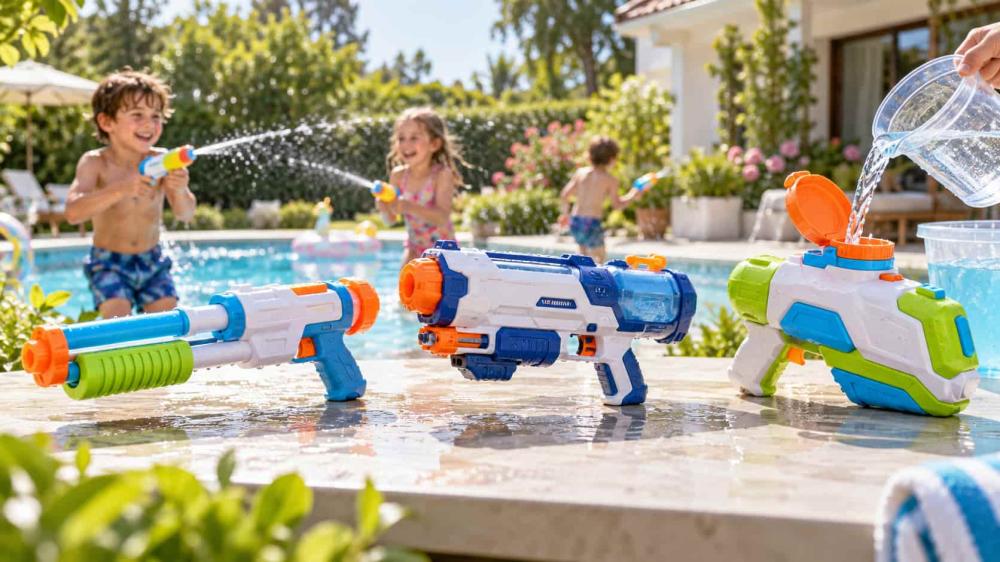
Blasters with fast-fill tanks from a hundred and seventy millilitres to half a litre, motorised jets with a steady strea...
Three Mechanisms, Three Ways to Throw Water
Water blasters separate by the mechanism that drives the water, and there are three: fast-fill that floods the tank in a second, a battery motor that gives a continuous stream while the trigger is held, and hand-pumped air pressure that builds force before release.
Your child's age settles which one fits, well before shape or colour. Fast-fill suits a small hand at five, while hand pumping needs the stronger grip that usually arrives after six.
Fast-Fill and Why It Changed the Game
Fast-fill works through a wide opening in the tank base, so a child dips the blaster into a basin and fills it without a screw cap or a funnel. That opening removed the thing that used to break play: the walk back to the tap and the queue there.
Tanks in this class run from a hundred and seventy millilitres to five hundred. Put a bucket in the middle of the yard instead of the distant tap, or fill straight from the rim of our pool range.
Battery Motors and the Continuous Stream
A motorised blaster gives a steady stream on one press, so the child neither pumps nor pauses. These models run on batteries and want a check each season, because a cell left inside corrodes the contacts.
This class suits children past eight, being heavier and longer. Take the batteries out for storage, and wipe the compartment with a dry cloth before closing it.
Hand Pressure and What It Teaches
Hand pumping builds pressure inside the tank and releases it in one burst, so a child learns that the result follows the effort rather than preceding it. Range in this class reaches eight metres at a length near forty-eight centimetres.
Some children tire of repeated pumping while others prefer that rhythm to a constant stream. Try both before buying two alike, and look through large-tank blasters if your child wants a bigger tank.
The Tank: Weight Before Capacity
A hundred millilitres of water weighs about a hundred grams, so a half-litre tank adds half a kilo to one arm. Lift the blaster full yourself before handing it over, because what feels light on display turns heavy after ten minutes of running.
Choose a tank your child can fill alone and carry alone. Mid-size tanks see more use at home than large ones, and the large ones belong to group play in play outside the house.
Printed Range Versus Real Range
Printed range is measured at an ideal angle with a full tank and full pressure. In real play the number drops to roughly two thirds, since children aim level and fire with the tank half empty.
Read it as a ceiling rather than an average. Six real metres covers a home yard, and longer range only pays off in open space.
What the Child Sees and What the Parent Sees
Children buy the shape and parents buy the mechanism, and the decision gets lost between them. Offer your child two models preselected for the right mechanism, and leave the choice of shape to them.
This works because it hands over a real decision inside sensible limits. Many parents hunt for a particular colour first, then discover the mechanism does not suit a small hand.
Many call this piece a water sprayer while meaning the same type. Browse the water play section to see the families side by side before narrowing anything down.
Group Play and Its Two Rules
Set two rules before the battle starts: no aiming at faces, and one shared filling bucket in the middle. Those two alone turn chaos into a game that runs half an hour.
Split the children into two teams with a line drawn between them. floating balls and kids floats add other elements once the pace drops, and our goggle range helps the child who keeps catching water in the eyes.
Two Models for Two Children
Parents ask about one blaster for two children three years apart. Buy two different mechanisms rather than two identical ones, since the children swap and play runs longer.
They ask about care between seasons. Empty the tank completely and leave it open until the inside dries, because trapped water is what blocks the nozzle next year.
Water play belongs outdoors only, since indoors it ends in slippery tiles and wet furniture. On days the weather rules water out, try light sports play from sports instead.


