Board games, ludo, bowling and wheeled bags for ages 5–6. See what happens when he first loses and how rules become part...
The first time a five-year-old loses, it does not pass quietly. He flips the board, announces the game is stupid, or cries with a force that surprises everyone, because a counter arrived before his did.
The father has two options in that moment: stop playing, or understand that this is precisely the benefit. Small repeated losses at home cost far less than a first loss in a classroom.
The First Time He Loses
What breaks is not anger at losing alone, it is surprise. Before five a boy plays in a world he controls, and a first rule-based game introduces something he does not own: an outcome decided by someone else, or by a die.
Start with a game whose round is short. A round that ends in five minutes gives an immediate second chance, and that softens the first.
Ludo and the Rule of Turns
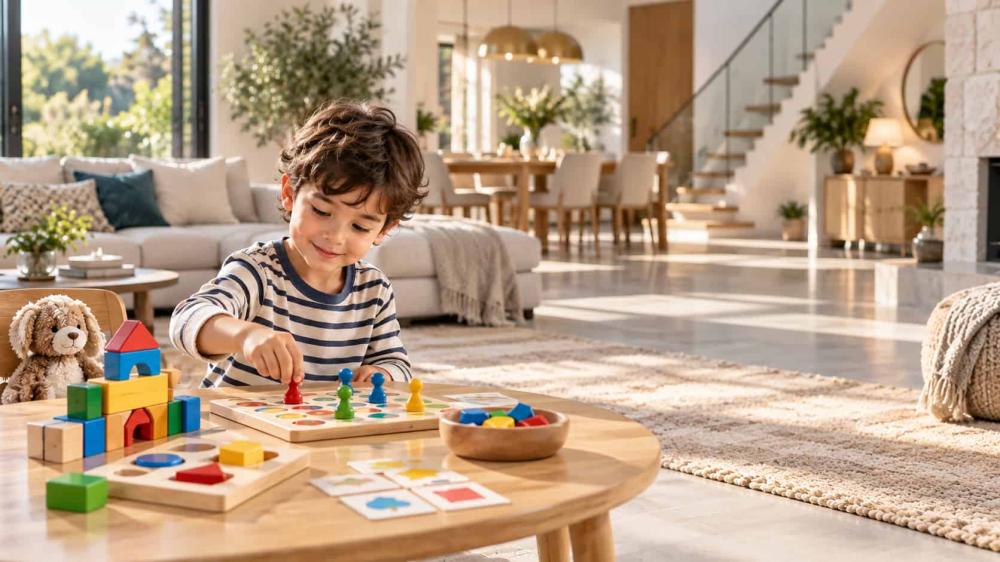
Ludo is among the smartest buys at this age, and the reason is structural: the wait is short and the luck is visible, so a boy does not carry the blame for losing.
A game like this gathers a house around one table for twenty minutes. Start with two players and add a third, since waiting grows with the count. Longer boards sit in the group games range.
The Session That Runs Twenty Minutes
Before five, a session is measured in a few minutes. At six a boy can hold one activity for a third of an hour if the activity is graded: easy at the start, harder step by step.
Nothing cuts a session faster than a sudden jump in difficulty halfway through. Watch where he stops. The same point repeats, and it tells you his limit today.
The Wheeled Bag and What Goes In It
A wheeled bag solves the shoulder problem in the early years, but it imposes two conditions: a handle that extends to his waist rather than his chest, and wheels that work on uneven ground.
Test it loaded. Push it one-handed across tile and across carpet. Whatever catches on carpet will catch in a school yard.
Bowling: From Knocking Down to Scoring
At four the pin falling is the whole pleasure. At six he counts, compares and demands a second round. The same set has become a numbers game.
The best sets at this age absorb that shift with no new purchase: one kit played three ways depending on distance and the rule agreed on.
Losing Without an Explosion
- Name the result calmly: "you came second" beats "you lost". Same meaning, different landing.
- Restart at once: a near second chance turns a loss into a stop along the way.
- Lose yourself sometimes and show it: a boy copies the reaction before he grasps the rule.
Luck-based games serve better at first than skill-based ones, because luck spreads the winning evenly. Skill games wait for a higher shelf on the boys stage ladder.
Why He Tires of His Younger Brother's Toy
The boredom here is social rather than physical. At six he is building a picture of himself and refuses whatever looks babyish, even when he enjoys it. The fix is to offer the same piece under harder rules: a longer distance, a set time, a running score. What cannot be upgraded stays in the three to four section for the smaller brother.
The second cause is that a younger sibling ruins the game without meaning to, and the older one loses interest. Separate them with a third shared game.
Three Questions Before Buying a Group Game
How long is a round? How many players does it take? And can the rules be grasped in a minute? Three short answers settle most of the shelf.
Anything needing a long explanation opens once and is forgotten. A rule printed on the back of the box in five lines gets played the same week. What starts harder than that waits for the main boys page and its higher shelves.
When the Rule Becomes the Fun
There is a moment when his stance on rules flips. He stops treating them as a limit and starts inventing his own: "we play so whoever steps on the line goes again." That is a clearer sign of social maturity than any test.
Games serve that moment when they are simple enough to be edited. A perfectly sealed game leaves him nowhere to add anything of his own.