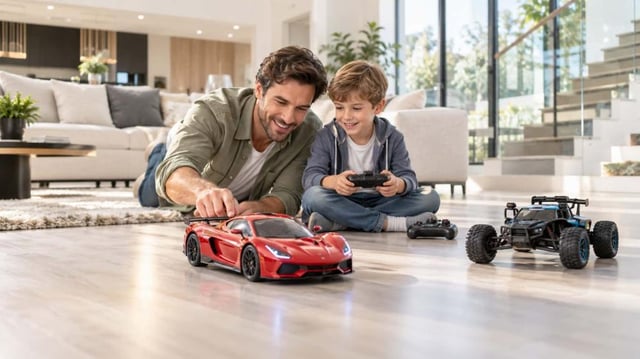

Remote control drones, helicopters, gliders and foam planes, from age three past twelve. Here is what separates the five...
Open a kids drone box, lift out the aircraft and the controller, then look at what is still sitting at the bottom: a charging cable, a spare propeller, a sticker sheet and a set of plastic guards for the rotors. Nobody counts those four pieces before buying, and they are what decides whether the toy flies for one week or one year.
Five ways to fly in the Baby Story section
The section is named after drones, and it holds more than drones. Here is what actually sits on the shelf:
- Four-rotor drones with a controller. They run on 2.4 GHz, take off and land with one button, and hold altitude so the aircraft parks itself in mid-air. Some models add obstacle avoidance, brushless motors and LED lighting.
- Winged RC planes. A light foam airframe, a battery that charges over USB, and enough power for loops and rolls.
- Gliders and foam throwing planes. No battery, no controller. You launch them by hand. One model spans fifteen inches, another runs forty-eight centimetres, and both switch between straight flight and a looping circle.
- Helicopters. Some fly on a controller with altitude hold. One rescue helicopter runs forty centimetres long, spins its rotor when you press the handle, and carries a working winch and an interactive screen.
- Buildable planes. Sets from 178 pieces up to 551, built to be displayed, and one of them rebuilds into three different aircraft.
The number printed on the box surprises most parents
A father looks for a drone for his six-year-old, then reads the age on the box: fourteen years. That is not a misprint and not caution for its own sake.
Most drone models in this section are marked fourteen and up, a few are marked eight, and the gliders and the rescue helicopter start at three. The reason sits in the fast-spinning rotors, the lithium battery, and a six-channel controller that expects hands which already know what they are doing.
A workable order of arrival: from three years, start with a glider or with the helicopter whose rotor spins from a hand lever. From eight, a child can fly a drone that holds its own altitude, because the aircraft corrects itself while he panics. Six channels can wait until ten. Anything younger that wants movement under its own hands belongs in electric ride-on cars or scooters.
What separates a drone from a helicopter from a glider
The difference is not the silhouette. It is the relationship between the toy and the room.
A drone stops in the air. Altitude hold lets it hover on one spot, which makes a wide room or a hallway workable.
A winged plane never stops. It needs distance ahead of it to stay up, and a near wall ends the flight.
A glider depends on you. No motor, so its range comes from your arm and your release angle alone. That is why some children lose interest in a week and others keep one for months.
Remote control does not stop at the sky either. A child who loved it in the air finds it again in remote control racing cars and in kids remote control boats, and anyone drawn to scale models and small vehicles will find them in the models and RC vehicles section.
Measure the space before you read the spec
The most common mistake we see is a parent who reads every specification and never measures the room.
- Indoors. A small drone with obstacle avoidance, or a foam plane thrown down a long hallway.
- The yard or garden. This is where a glider opens up its full range, and where the stomp rocket plane works: you launch it by stepping on a foot pump, and the whole rig runs sixty-four centimetres, so it wants flat ground.
- The park and the beach. Outdoor play has its own home in summer toys, including the kind that mixes water with movement.
One rule covers it: a plane you have to run after needs a place you can run in.
What Baby Story customers ask before a first plane
- Do I need batteries? The aircraft itself charges over USB on most models, while the controller asks for two or four cells depending on the model. Read the box before the first flight.
- What if a propeller breaks? A spare propeller ships inside the box on several models, and the rotor guards cut the breakage down at the source.
- Will it fly indoors? A small drone will. A winged plane will not.
- From what age can a child fly alone? From eight with a drone that holds altitude. Before that, a parent's hand stays on the controller for the first two flights.
- And the stickers? The sticker sheet comes with the gliders and foam planes, and the child applies them himself, which turns it into his plane rather than anyone's plane.
The last sentence
Do not start from the strongest model. Start from the nearest age. The plane a child flies on his own in the first week stays with him. The one that waits for a parent's hand every time ends up on top of the wardrobe. Read the number on the box before you read the specification.