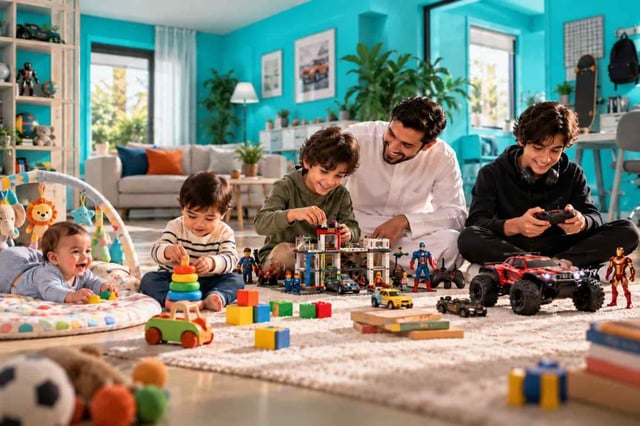

One toy gets solved in five minutes and shelved, another gets repeated thirty times over. The structural difference betw...
There is an educational toy your child solves in five minutes and then leaves on a shelf for the rest of the year. And there is another, at a similar price and in the same category, that comes back out thirty times in a fortnight.
The difference is not build quality or brand. It is one structural thing: does the toy have a single solution or many paths? Knowing that difference means buying one toy instead of three.
1. Solved once against played again
A single-solution toy ends when it is completed: a puzzle with one picture, or a board where each shape drops into its hole. Your child masters it and loses the reason to return.
A multi-path toy gives a different result each time: pieces that build many ways, cards that sort by more than one rule, a book that wipes clean and starts again.
That does not make the first kind poor. A younger child needs mastery and reassuring repetition, while an older one tires of it and wants a challenge. The question is not which is better but which suits your child's age now.
2. An age ladder from one to six
- One to two: large shape sorting, stacking, pulling pieces out and pushing them in. The skill here is more physical than mental.
- Two to three: colour matching, four to six thick puzzle pieces, and the beginnings of sorting.
- Three to four: letter and number puzzles, sequencing, and logic puzzles that tie a thing to its place.
- Four to six: simple arithmetic, word building, and larger puzzles with finer pieces.
The real jump falls between three and four: before it a child matches what they see, and after it they work out what they cannot see.
3. Shape sorting: a first encounter with rules
A sorting board looks like the simplest thing on the shelf and runs among the deepest. A child holds a triangle, looks at three openings, tries one that refuses it and tries another that takes it.
That is the first time they meet a rule that does not bend however much they insist. The piece neither flatters them nor scolds them, and that alone builds a patience no explanation can build.
Start with three shapes rather than six. A board with many openings unsettles a child in their first year and makes them abandon the whole thing.
4. Letters and numbers: when they genuinely start
This question reaches us more than any other: when should I buy a letters toy? The answer is that age is not the signal. Three signs on your child are:
- They point at a letter on a sign and ask about it themselves.
- They pick their own name out from among other names.
- They count to five in a fixed order without skipping.
Two of the three appearing means they are ready, even if they are younger than the box says. Buying before that turns the toy into homework they refuse.
5. Logic puzzles against picture puzzles
A picture puzzle assembles an image, and the proof of success is that the shape completed. A logic puzzle ties a thing to its place or its tool: an animal to its habitat, a job to what it uses.
The practical difference is that the first is solved by looking at edges, while the second yields only to thinking about a relationship. Which is why a logic puzzle lasts longer with the same child.
The full range by size sits in the puzzles section, and the wooden ones in assorted puzzles.
6. Water activity books and who they suit
A book coloured with a water pen whose colours then fade and let you start again solves two problems at once: mess, and boredom with an activity that ends.
It works in three places specifically: the car, a waiting room, and travel. Those are the places where pens do not belong and small pieces roll away.
The pen matters more than the book: a thick pen suits a child gripping with a whole fist before the three-finger hold matures.
7. When an educational toy becomes homework
There is a thin line plenty of parents cross with good intentions, where the toy shifts from something a child chooses to something asked of them.
Three signs say you crossed it: you ask what they learned after each session, you correct them while they play, or you attach a reward to the toy.
The alternative is simple: leave the toy within reach without comment, and play with it yourself in front of them occasionally. Children copy what looks enjoyable and resist what arrives as a task.
After the thirtieth time
Choose by your child's stage rather than by the box alone, and start with three shapes on a sorting board rather than six. Wait for two signs out of three before buying a letters toy, and favour logic puzzles over picture puzzles for a child who bores quickly. Then leave it within reach without a question after every session.
For wood and self-correction, see the Montessori range. To equip a full school year, start at the back to school corner then nursery and primary bags, with the meal in school food containers and the bottle in daily school kit.