
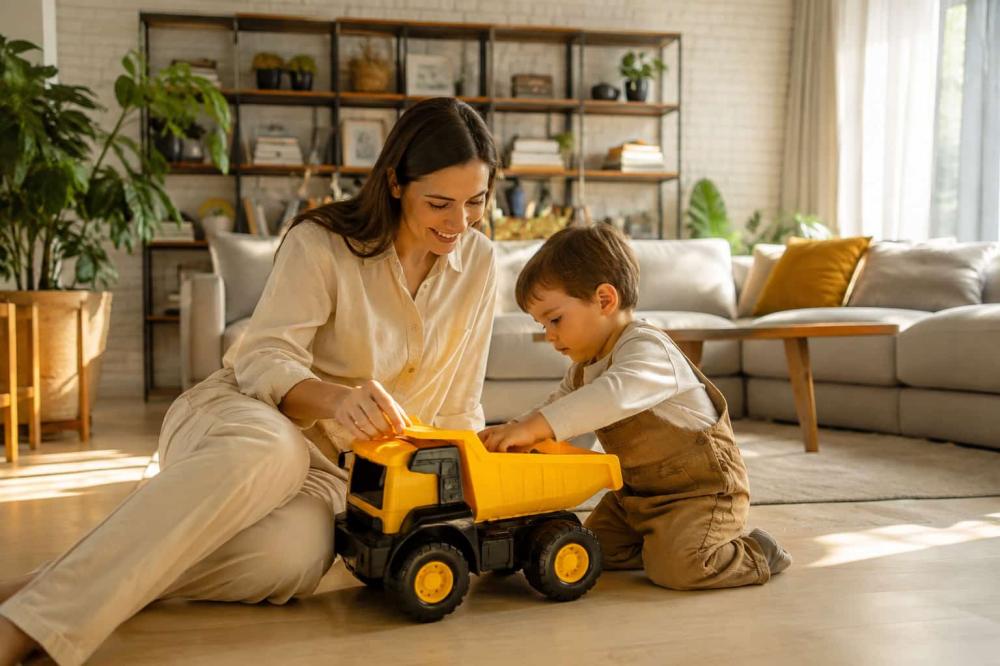
Metal tipper trucks, fire engines with water tanks and friction city vehicles from age three. Why children bond with the...
Watch a child play with a truck and you will need no explanation. He makes the engine noise with his mouth, rising as it climbs, falling as it stops, then a siren as it arrives. Nobody taught him that.
That sound is the whole difference. A fast car plays by itself; a truck is played with. A truck therefore stays in a child's hands for months after faster cars are forgotten.
Because a truck has a job, not a speed
A car arrives. A truck carries something and arrives. That extra word opens a whole world: carrying what, from where, for whom.
So he starts gathering blocks and loading them, then builds a site to unload at, then invents a reason for the journey. That is complete imaginative play, grown out of one truck.
Because something on it moves under his hand
The bed rises, the arm swings, the ladder extends, the tailgate drops. Every moving part gives a child an action to perform instead of a scene to watch.
At this age the gap is enormous. A toy that moves on its own entertains for minutes; a toy he moves occupies him for an hour.
Because it copies grown-ups
He sees a bin lorry in the neighbourhood every week, a fire engine on television, and a tipper at a site near the house. Then he holds a small version and becomes the one driving it.
Playing the adult is among the deepest drivers of play. Which is exactly why service trucks succeed: fire, ambulance, police and refuse.
Three families and what separates them
- Haulage and tippers. Their essence is loading and unloading. They suit a child who likes to fill, empty and refill.
- Rescue trucks. Fire and ambulance, with ladders, hoses and sirens. They suit a child who wants a story and a role.
- City trucks. Refuse, cleaning and delivery. They suit a child copying what he sees on the street.
Do not buy all three. Buy one and watch which he returns to on the second day.
Age three to five: size and friction
At this age a good truck is relatively large, has nothing that detaches, and runs on friction or a push. Friction suits especially well, because it gives motion with no battery and no waiting.
Look for at least one moving part he can work with his own hand. A completely sealed truck becomes a model rather than a toy.
Age six and up: remotes and functions
Now remote control and button-operated arms make sense. A remote truck combines two pleasures, driving and a mission. The control detail and level guidance sit in the remote control cars by level.
Read the age on the box, because some larger models carry a higher age warning for small parts rather than for speed.
Metal or plastic: which one is yours
A metal body weighs more, so it holds steady in a child's hand, does not roll on a bend, and takes impacts better. Plastic is lighter, so a small child lifts it one-handed, and it washes clean after sand play.
The practical rule: metal for a child playing on tiles, plastic for a child playing in sand and in the yard.
Where a truck plays best
Not on carpet. A truck needs a surface that carries its load and lets the wheels turn, and it needs material to move: sand, blocks or gravel.
Its best home is a sandpit, or a tiled corner with a box of blocks beside it. For indoor play it helps to run alongside the ready-made play tracks, so the road takes a shape.
What plays with it and completes it
A truck alone is incomplete, and is completed by whatever works with it. Diggers and tractors come closest: the digger fills and the tipper carries, so your child has a working line rather than a toy.
Anyone wanting to widen out across vehicles finds them in the types of toy cars, and anyone wanting a fast sporty shape finds it on the racing and models shelf. For a younger sibling there are hand-pushed vehicles in push cars for little ones, and for a child whose interest turns to water there are craft that work in it in the boats section.
When the rescue mission ends
Do not buy a truck because it is the biggest or has the most buttons. Buy one that carries something and tips it out, then set a bucket of sand or a box of blocks beside it. A truck with nothing to haul ends up on a shelf.