Barbie clothes, dresses, prams, beds, wardrobes and care sets, in sizes that differ between brands. Here is how to measu...
Two-wheel kick scooters and kick scooters for older children, together with helmets, locks and bags in a single section.
A child outgrows a scooter in roughly two years and a helmet in three. Anyone buying both on day one replaces both together afterwards, paying twice for what would have covered them once and a half. It is the most common arithmetic mistake in this section, and avoiding it needs nothing more than the right buying order.
Why we keep scooters and their kit in one section
Because a single ride needs all of it. A scooter without a helmet is an incomplete order, a scooter parked outside a school without a lock is a risk, and a child holding a water bottle in one hand and a bar in the other is steering one-handed.
We arranged the section to answer "what else do I need besides the scooter" on one page instead of sending you hunting for each piece separately.
Where kick scooters sit among the types
This is the type the child moves with their own foot rather than a battery. It comes in two shapes: three wheels for younger children from age two, and two wheels once balance is built.
Two-wheelers live in this section specifically, while smaller sizes sit in three-wheel scooters for younger children. Anyone past the balancing stage who wants a motor will find motorised scooters, and anyone wanting a seat will find drift scooters for older children.
Three details that separate a scooter that lasts from one that does not
- The standing deck. It must take a whole foot with room for the second beside it when stopping, and its surface should be textured rather than smooth. A smooth deck slips under a damp sock or a wet shoe.
- The bar lock on folding models. It should click audibly into place. A silent lock means a mechanism that weakens over time and folds itself while your child stands on it.
- Handlebar adjustment range. The difference between a model with two settings and one with ten is two extra years on the same scooter.
Checking a two-wheeler with your hands in two minutes
Four movements reveal more than any written description:
- Push the scooter once along the ground and let go. A good one travels a distance and comes to a quiet stop; a poor one rattles and stops within a few metres.
- Press a thumb into the wheel. If it gives slightly it is polyurethane; if it does not move it is hard plastic.
- Squeeze the rear brake by hand. It should flex under light pressure and spring back, because a stiff one will defeat a child.
- Fold and unfold it three times. If folding is heavy or needs force, your child will never do it alone.
We run all four on any model before it reaches our shelf, and we will run them again with you at the shelf if you like.
The buying order that saves you money
- Scooter and helmet together. The helmet is not an add-on but part of the order, and we do not close one without asking about it.
- The bag after a week. Once you have counted how often your child carried something by hand while riding.
- The lock when needed. The day the scooter starts going out to public places with you, not before.
That order stops you buying what never gets used, and stops you discovering the gap on the first ride.
The three accessories and what separates them
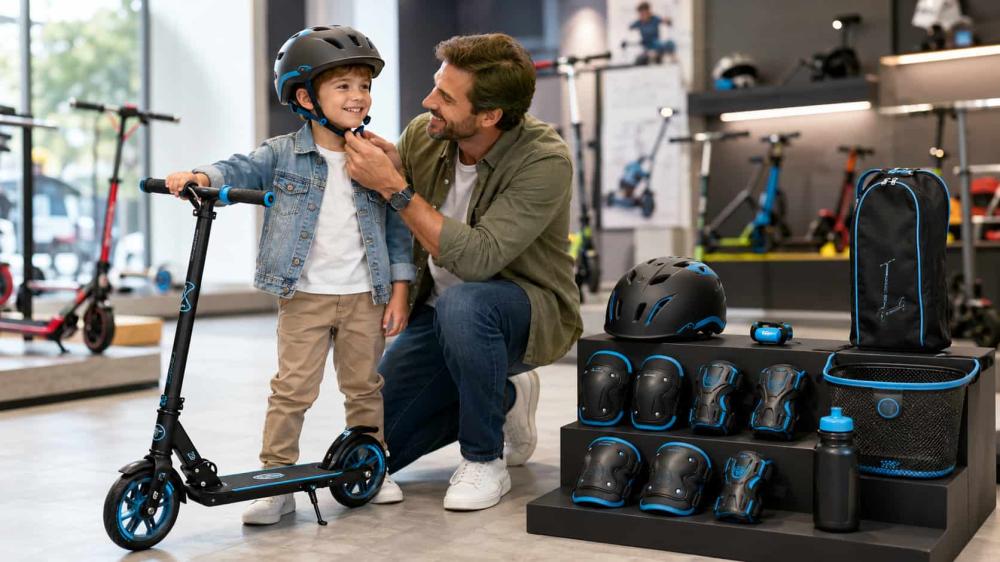
- The helmet. Sized by head circumference in centimetres rather than by age, and its weight decides whether it stays on. The gap between our lightest and heaviest is close to double.
- The front bag. Straps to the stem and frees the child's hands. What matters most is strap width, since narrow ones shift with every bump.
- The lock. Steel cable, numeric code or fingerprint. Pass the cable through the wheel and the frame together rather than around the frame alone.
All three fit any scooter in the shop, so you will not be buying them again with every new model.
Where the "do not pay twice" sum comes in
These items do not expire together. A scooter ends at its weight limit or at leg length, a helmet ends at head circumference, and a bag never ends at all because it straps onto any scooter.
So when you buy the second scooter two years from now, you will usually need a new helmet and the old bag will do fine. Which is why we suggest spending once on a bag and a lock that last, and counting a helmet into the cost of every scooter rather than once.
What wears out first, and how Baby Story handles it
The front wheels, whose edges go on rough tarmac before anything else. The tell is a scooter starting to pull to one side while travelling straight, or sitting slightly tilted on level ground.
Before you think about a new scooter, check the wheels on their own. Plenty of scooters return to normal with one small part, and that is worth asking about before replacing the whole thing.
What a Baby Story assistant sets up for you
We measure your child's head with a tape at the helmet shelf, set the bar at mid-chest while they stand, and ask for one push and a stop. Three steps in five minutes prevent an order that comes back a week later.
Helmets by size sit in helmets in your size, and the rest of the types in scooters at Baby Story. A child not yet two starts at the ride that comes before a scooter.
If you are in Jeddah, visit Shatea, Tahlia or Basateen, and orders placed before six in the evening reach Jeddah addresses the same day.