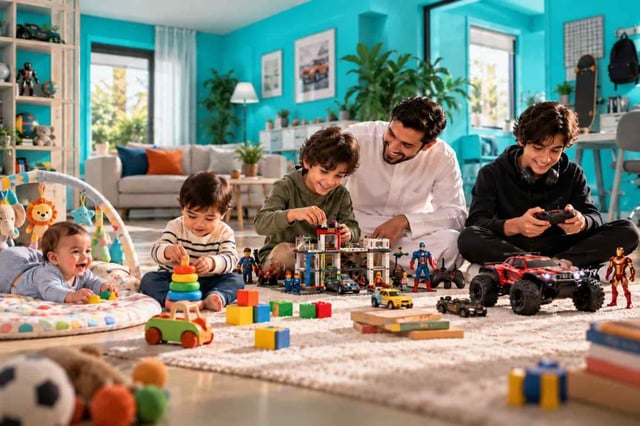

Floor bowling, blocks, squishy balls and cutting activities with safety scissors. What twelve months change, and why buy...
One box, two boys a year apart. The first opens it, tips out the parts, lines them up by colour and is satisfied. The second turns the lid over, studies the printed picture, then starts trying to reach it.
One year sits between them, and the difference is not manual skill. It is the presence of a goal. That inverts the buying test: what suits three can bore four inside half an hour.
1. One Year Between Three and Four
A three-year-old plays with the material itself: texture, colour, sound. A four-year-old plays with the result. He wants to make something that can be shown.
So a set aimed at four needs a clear finished image on the box, while a set aimed at three succeeds with no image at all.
2. From Taking Apart to Putting Together
Dismantling comes first. He pulls things apart to learn what is inside, and destruction is not the intent. Assembly follows once the mental picture becomes clearer than the parts.
A first successful build has three visible steps and no written instructions. Any kit that needs reading waits until after five.
A simple two-button car belongs to the same family: he presses and it moves, he lets go and it stops, linking action to result in a second. The detail sits in boys cars.
3. When He Starts Naming What He Builds
Naming is a large jump. The same pieces become an airport or a bridge, and the rules of play change because he is now serving a story. Portable pretend sets enter here: small kits that gather into one cup and open in a car or at a relative's house. What comes after sits in the five to six section.
Do not correct the name. A tower he calls a ship is a ship, and correcting it stops the play immediately.
4. Scissors and the First Real Tool
Plastic safety scissors open a door many parents miss. Cutting needs the hand to open and close in rhythm, the same motion a pencil will need two years later.
Start with short straight lines, then a wide curve, then a closed shape. Activity books with twenty graded pages beat blank paper, because a printed line tells him where to go.
5. Ten Pins and Counting Points
Floor bowling works at this age on one condition: keep the distance short. Three rolls from a metre, four rolls from two.
Counting enters after four. Before that the fall itself is the reward and the number means nothing, and pushing scoring early turns a game into a lesson he abandons.
6. Soft Balls and What the Hand Does With Them
Squishy balls are the simplest tool for releasing small tension. Repeated squeezing works the little muscles of the palm, the same ones that tire when writing begins.
Avoid the kind that splits and leaks its filling. Press one with your thumb before buying: what returns to shape very slowly will crack early.
7. The Piece He Breaks and What It Tells You
Repeatedly breaking one kind of part is a message. If only thin parts break, his grip has outrun the size you are buying, and the sturdier tier solves it without any lecture. If he breaks to see inside, he needs a different type: something designed to come apart and go back. You will find both in the boys section.
Note which piece broke and how. Three similar incidents are enough to change your buying standard.
8. When He Moves to the Five Shelf
Three signs: he sits twenty minutes on one activity, he accepts waiting a turn at least once, and he tries again after failing instead of walking off. A parent seeing all three should buy for five. The full map is in the boys age sections.
The four-year shelf stays in use after the move, especially anything played on the floor.
What Twelve Months Changed
At three he plays with his hands. At four he plays with his head and hands together. The same parts can serve both, and the difference is presentation: open it and hand it over at three, show the picture and step back at four.
Buying four-year kits for a three-year-old buys a week of quiet and then an abandoned shelf. Buy for the age in front of you.