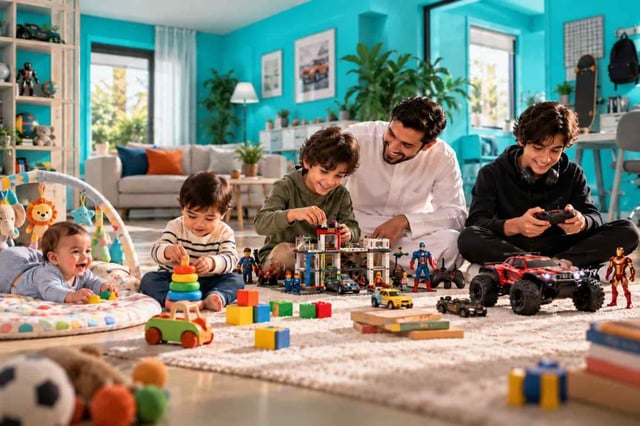

Chunky blocks from eighteen months, crawl tunnels, foam flooring and pull-along toys, each sized for a one-year-old grip...
In every home with a child between one and two, one observation repeats: a toy she drags behind her on a string comes out daily, while a toy she pushes in front of her stands in the corner within a week.
Both cost the same and rest on nearly the same idea. The difference is that at this age she needs to see what she is moving, and the pushed one disappears in front of her with every step.
1. What changed between month nine and month twelve
Three shifts rewrite the shopping list. Her hands come free of propping her up and become busy, she stands so her eye level moves two feet off the floor, and she starts predicting a result before acting.
In practice that means sitting-down toys lose their pull abruptly, and anything that travels with her while she walks wins.
2. Pulled behind against pushed ahead
A pull-along on a string stays inside her sight line when she turns, so she ties her tug to the movement of the wheels. It suits her from the moment she walks a few steady steps.
A push-along in front asks for steadier walking and better balance, because she leans on it and steers it at once. A child who has only just started walking pushes it, it outruns her, and she goes down.
The order we see working: pull-along first, push-along two or three months after walking settles.
3. The piece size her hand closes on
The test we run at the shelf is simple. The right piece at this age is one her palm closes around with the thumb still visible on top. Smaller than that and it drops constantly; larger and she needs both hands, so carrying and walking stop happening together.
That is why we suggest large blocks before eighteen months and smaller ones after.
4. Blocks in the second year: stacking and knocking down
Do not expect building. She stacks two or three pieces, knocks them over, and repeats twenty times. The knocking down is not destruction but half the game, since it is the part she controls completely.
Start with four pieces rather than twenty. A full box unsettles her at this age and gets emptied onto the floor instead of played with.
Resist correcting the tower. A hand reaching in to straighten a piece ends the experiment before it finishes.
5. Tunnels and flooring: play that uses the whole body
A crawl tunnel stays wanted after walking arrives, and its use changes. She walks through it stooped instead of crawling, comes out the far end to find someone waiting, and repeats it again and again.
The floor underneath matters more than it appears. Foam softens the sound of a fall and invites sitting down and standing up repeatedly, while tile shortens the session for no visible reason.
6. Why one toy lasts and another stops at this age
- Lasts: anything answering instantly on every touch, because the repetition itself is the pleasure.
- Lasts: anything that empties and fills, since tipping pieces between two containers holds her longer than assembling them.
- Stops: anything needing two steps in sequence, because she forgets the first one.
- Stops: anything resting on a story, since pretending has not begun at this age.
7. Three signs she has moved on to two
- She carries a piece and walks a distance without dropping it.
- She posts a shape into its hole on the first or second try rather than the tenth.
- She returns a toy to its place when asked once.
Two of the three is enough to move up. What comes next sits in what suits four.
8. What parents ask first at the toddler shelf
When do I buy a game with rules? Not now. Rules begin past four, and before that comes parallel play, where she plays beside another child rather than with them.
Do sound toys work? Yes, provided the sound follows her action rather than running by itself. A toy that sings untouched becomes background she tunes out.
What she comes back to every morning
Put pull-along before push-along until walking settles, and test the piece against her palm before you pay. Start with four blocks rather than twenty, and let the knocking down finish uncorrected. Move up when two of the three signs appear.
For a girl not yet one, see baby girl toys. The whole shelf sits in the girls' section, and the six stages in order in the age ladder for girls.