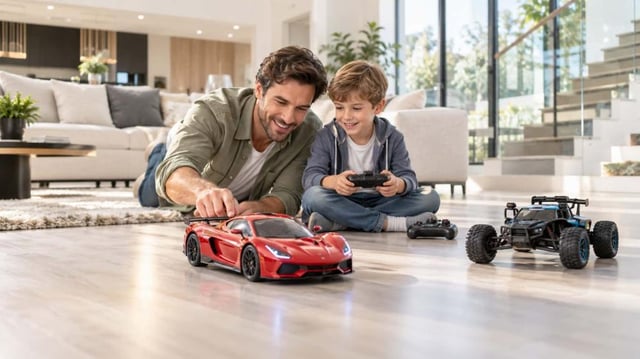
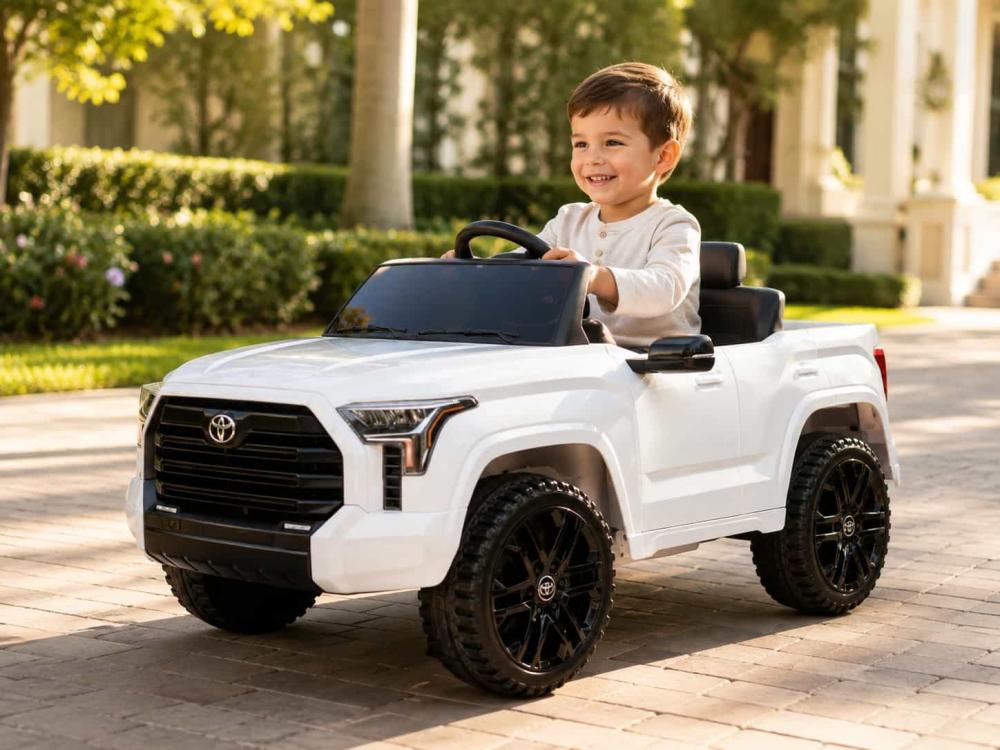
Push cars with a parent handle and electric ride-ons from age one to eight, in one and two seaters. Here is how they dif...
Start at the end: a ride-on car parked in a storeroom corner after three months. Nothing broke and the child never lost interest — it simply never made it through the door, because it measures eighty centimetres across and the hallway measures seventy. One decision would have prevented that, and it comes before any choice of model or colour.
The first thing that confuses a parent here is that four genuinely different products sit under one name. Let us separate them.
Two types here and two neighbours
What they share is that a child sits on them. What separates them is where the motion comes from:
- Push cars. The child pushes with their feet, or a parent pushes from a rear handle. No battery.
- Electric. A battery, a motor and a pedal, with the child steering through a wheel.
- Rockers. They move with the child's body weight on a curved base that never rolls away, and they sit in a neighbouring section rather than this one.
- Ride-on motorbikes. Steered by handlebars rather than a wheel, and a family of their own.
The common mix-up sits between the last two: a parent looking for a vehicle with handlebars does not want a car, and the reverse holds just as firmly.
Push cars: the first vehicle a child owns
These start around the twelfth month, the stage where a child walks but cannot yet push along with their feet. That is why the models carry a long rear handle for the parent and a plastic floor panel that shields small feet until they are ready to drop.
Load limits sit around twenty-two kilograms on common models, which carries most children to four or five depending on build. The range sits in the push car section.
Electric: when driving becomes the game
Here the purpose of the toy changes entirely. The child spends no effort and instead learns steering, stopping and watching what lies ahead. Three numbers govern the category: battery voltage between six and twenty-four volts, load between thirty and sixty kilograms, and speed between three and eight kilometres per hour on younger models.
Most models include a 2.4G parent remote that stops the car from a distance. The full range sits in kids electric ride-on cars.
One stage earlier: the rocker
A child not yet ready for anything that rolls still has an option that moves on the spot. Its curved base tips with their weight and builds an early sense of balance, and it is the best answer for a narrow home or a furnished room because it needs no corridor at all.
That section sits beside ours rather than inside it, and you will find it in rocking horses.
Space before model
Lengths in this section run from forty-eight centimetres on the smallest push car to one hundred and forty-two on the largest six-wheel electric truck. And the space you need is not the length alone — it is the length plus the same again in front of it to turn.
One practical measurement before you open a single product page: walk the corridor the car will use and measure its narrowest point. That number eliminates half the options immediately and spares you the comparison.
How we arrange the four types at Baby Story
Shelving in the branch follows age rather than shape. Lower shelves start with what a one-year-old rides, and each shelf climbs a stage until the twenty-four volt models at the end of the row. The reason is plain: a parent walks in holding a child, and the child reaches for whatever sits at eye level.
Walk that row from one end to the other and you see each stage solving a problem the previous one left behind. The push car solves the child who walks but cannot run. The rocker next door solves the home with no corridor. The electric car solves the child who has tired of supplying the effort and wants to drive.
Two questions that settle push against electric
First: do you want the toy to tire your child or entertain them? A push car burns energy, because the child pushes with their legs and climbs the slope on their own effort. An electric car entertains without burning anything, because the motor does the work.
Second: who holds control? With a push car the handle stays in the parent's hand and control never leaves. With an electric car control passes to the child, and the parent keeps a handset that stops it from a distance. That is a difference in responsibility, not in technology.
A parent buying for a two-year-old has an almost settled answer: something they push themselves. A parent buying for a five-year-old who saw a car at a cousin's house is answering in the other direction.
Three numbers to read before buying
- Maximum load in kilograms. This decides how many years it serves, not the age printed on the box.
- Width in centimetres. Compare it against your narrowest doorway.
- Battery voltage. On electric models only, and it points to both speed and age bracket.
When a ride-on car is the wrong answer
When the ground is sand or gravel, because wheels dig in and the motor strains. When the home has no straight run longer than two metres. And when a parent wants a toy that builds leg strength and real balance — that job belongs to the bicycle section and three-wheel trikes, not to a vehicle that moves on a battery.
For yard activity with no wheels at all, look at large outdoor play equipment. For a vehicle the child stands on rather than sits in, the place is kids scooters.
If you read nothing else
Measure the corridor first, read the load rather than the age, then pick the type by what you want for your child: effort from their own legs, driving on a battery, or rocking on the spot. The rest of the range sits in the ride-on car collection. Under age one, a rocker still beats anything that rolls.