Diggers, farm tractors, mixers and friction city vehicles from age two. Why construction toys make a good first vehicle,...
The first moving toy in a child's life is better off needing no battery. A battery means waiting, and at two years old waiting means the toy has stopped and will not come back.
Construction vehicles run on his hand or on friction, so they move when he wants and stop when he wants. That alone qualifies them as his first vehicle.
1. Friction: movement with no waiting
The child pulls the vehicle back or shoves it hard, storing the motion in an internal flywheel, and it then runs a metre or two by itself. No switch, no charging, no battery hatch needing a screwdriver.
More importantly, he sees the result of his own force at once: push harder, travel further. That is a cause and effect relationship he grasps at an age when explanations mean nothing.
2. Moving parts make half the toy
The digger arm swings, the bucket drops and lifts, the mixer drum tilts, the tractor tows a trailer behind it. Every one of those is a movement his fingers learn.
It is genuine fine motor training that never looks like training. He thinks he is digging; in truth he is learning grip, rotation and control.
3. Age two to three: size before detail
Look for a vehicle that fills his palm and will not fit his mouth, with wide fixed wheels that do not come off, and a single arm that moves without a delicate joint.
Soft blocks that come with a vehicle work particularly well here, because they combine building and carrying in one toy, and they survive squeezing, chewing and throwing.
4. Age four to six: the whole site
Now a child starts making a story: this is a site, this is a hole, this truck is waiting its turn. He needs more than one vehicle to complete the scene.
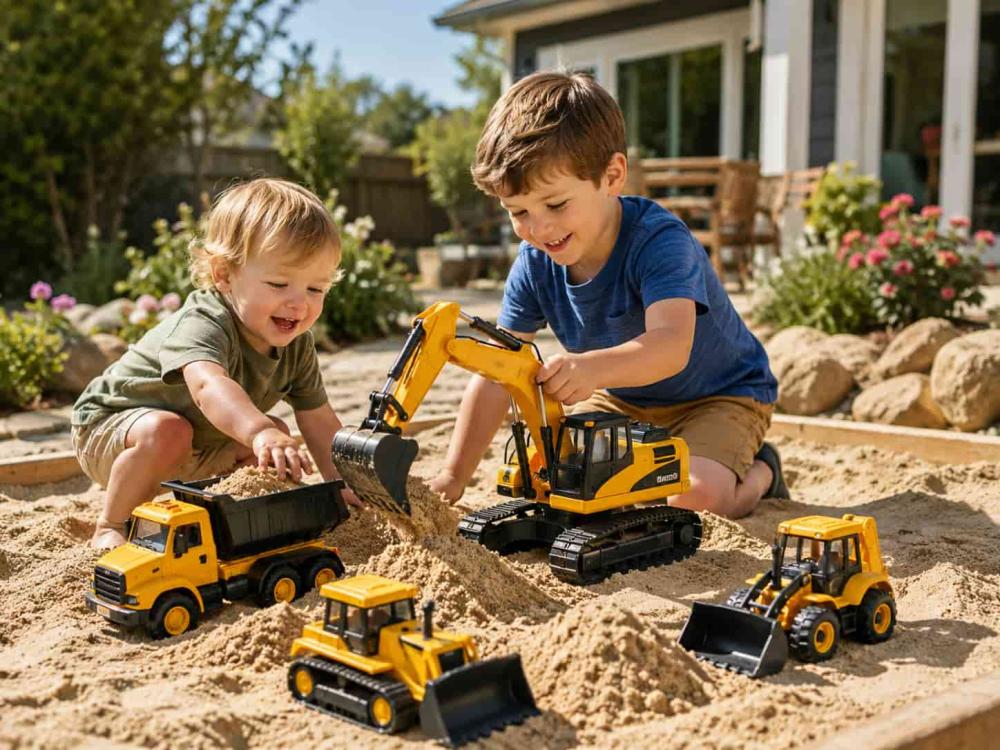
The natural addition is the tippers and big trucks, because the relationship between a digger and a tipper is real work: one fills and the other carries. That takes play from a single vehicle to a crew.
5. Farm, city and work site
- The work site. Digger, bulldozer, crane and lifter. Their essence is digging and lifting.
- The farm. Tractor, trailer and plough, plus animals and a small farmer. Their essence is the journey and looking after things.
- The city. Refuse, mixer and cleaning. Their essence is what he sees on his own street each week.
The farm works better with younger children because it has characters; the work site works better after four because it has a mission.
6. The surface that allows real digging
Sand is the best surface for construction vehicles without argument, because it is the only material that allows real digging. After that, a shallow tray of rice or lentils.
Indoors, a plain rug with a box of blocks does the job: he fills and empties, and keeps digging something even if it is only blocks.
7. What these vehicles build in particular
Three things a fast car does not build:
- Sequence. Dig before carry, carry before tip. An order of steps that allows no skipping.
- Patience with something slow. A digger races nobody, so a child gets used to enjoyment that does not depend on speed.
- New words. Digger, bucket, arm, tipper, tractor. Vocabulary entering his language through play, not through a book.
8. From a construction toy to what follows
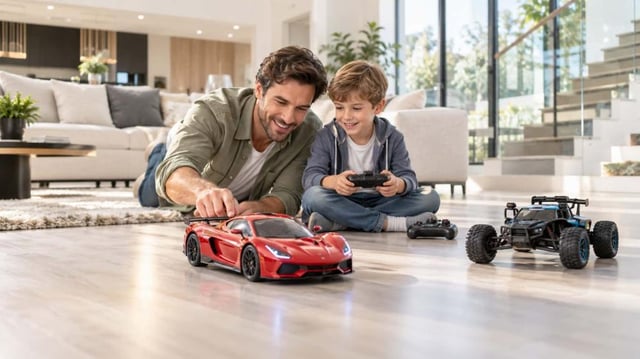
Once a child masters hand control and asks for something that travels further, he is ready for the next step. The remote control range is the natural destination, and most children who began with a digger ended up steering a car by handset.
A child who wants a road rather than a site finds it in the tracks range, and the whole family is laid out in the full toy vehicles section.
9. When he grows and wants to ride
A day comes when he says: I want one I can sit in. That is a natural move from the vehicle he pushes with his hand to the vehicle that carries him.
His destination then is vehicles that carry a child, or the electric cars section if he wants a motor and a pedal. A child whose interest stays with steering at a distance rather than riding finds the extension in the planes and drones section.
When his hand is enough
Do not rush the battery. The first two years of vehicle play belong entirely to a child's hand, and anything that runs by itself at this stage distracts him from the most important discovery of all: that he is the one who makes things move.