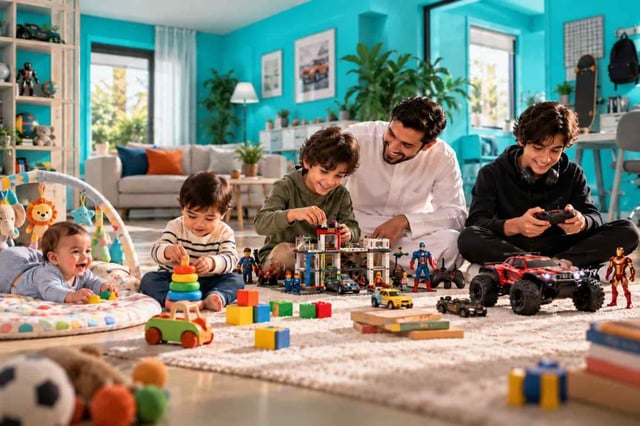

Crawl tunnels, play gates, foam flooring and baby toys covering the first twelve months. What suits week one, and what w...
Three near-identical boxes in a corner, one of them still bagged four months on. That is what the first week of visits leaves behind in a house with a newborn.
Most givers buy for the moment of the visit rather than for the child's year. The list below is ordered by month rather than price, because the month decides which gift opens today and which one waits.
1. Week One: What Arrives Before the House Opens
A newborn does not play in his first week. He sleeps, feeds and looks a short distance. What you bring serves the mother rather than the baby: something to spread, something to clean with, something to organise.
Gifts at this stage work when they can be used the same day. Anything needing assembly or floor space should wait, because a house in its first week cannot absorb a new box.
2. Month Six: When the List Changes
Between four and six months deliberate grasping begins, then supported sitting. Doors open that were shut: parts a whole palm can hold, surfaces that give a soft sound under pressure, high-contrast colours read at close range.
Anything arriving in that month is used immediately, which makes month six the smartest window for a giver who missed the birth.
3. The Gift That Arrives Twice
The fix is practical rather than charming: ask. One sentence to the mother saves two months of storage. Where asking is impossible, choose something consumable or something that gets spread out, since duplicates of those never annoy anyone.
Buying blind, the safer pick is a piece that grows with the child instead of a piece for one month.
4. Foam Flooring and the Edge of a Play Corner
Flooring is the most overlooked gift and the most used. Its squares lay out in a corner and become a visible boundary the baby learns: here I play, and here the zone ends.
Measure before buying. A common foam square runs thirty centimetres a side, and nine of them make a corner that carries a child to the end of crawling. Buy an even count so it tiles cleanly.
5. Buying for Sitting Against Buying for Crawling
A sitter needs what is in front of him: surfaces, buttons, parts passed hand to hand. A crawler needs a route: a tunnel to pass through and a gate that keeps him off the stairs and out of the kitchen.
Two months separate them, and the difference in use is total. That is why mothers ask about the month, never the year.
6. Wrapping and the Card: A Detail That Decides
A newborn gift is usually opened in front of visitors and photographed. Wrapping here is part of the gift rather than decoration on it, and the card solves a small problem: after a birth nobody remembers who gave what.
Wrapping and card come with the order, and the same applies to anyone buying from the boys section for an older brother on the same visit, or from the car shelf if that brother is at the vehicles stage.
7. What Goes to the Boy and What Goes to the Mother
The real list is two lists. One for the child: what he holds, mouths and watches. One for the mother: what cuts mess, eases cleaning and frees a hand.
The successful gift usually comes from the second list, because a baby in his early months needs very little. For something that serves longer, the toys for two-year-olds shelf starts at eighteen months and its pieces enter early.
8. Three Mistakes on a First Baby Gift
- The small part: anything that passes through a narrow tube does not enter a house with an infant. The rule holds for at least two more years.
- Loud sound: whatever rises above ordinary conversation gets moved to a far shelf by day two.
- Clothes in today's size: newborn sizing ends in six weeks. Take the six-month size.
The whole list narrows to three kinds: what gets spread, what gets held, and what keeps him safe. Everything else waits for the stage ladder to reach it.
The Gift That Opens the Same Day
A month later two things remain: what was used the same day, and what opened a new door once its time came. A gift that manages either one worked. A gift that manages neither moves on to another house.
The whole list reduces to a single question: what will this mother actually reach for tomorrow morning?