
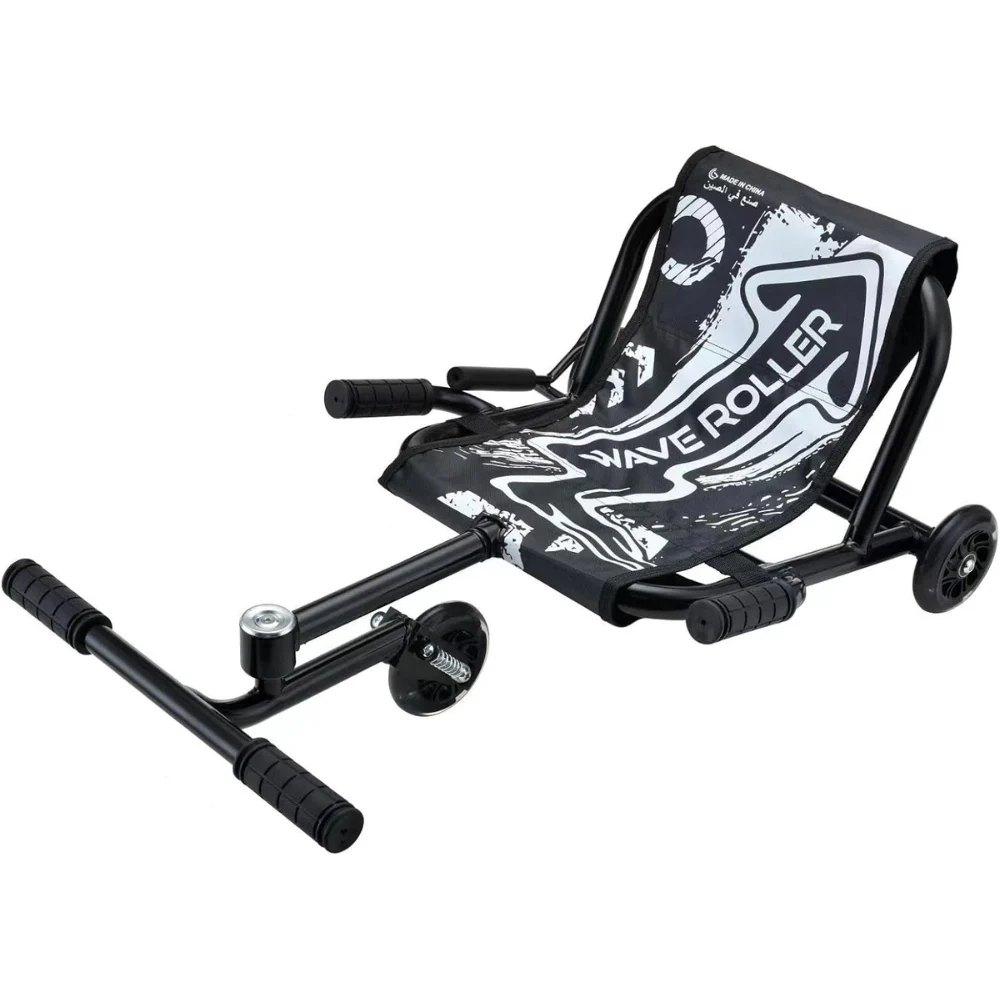
Drift scooters with a wide seat, three speeds, lights and a built-in mic, carrying up to 65kg from age six. Here is how...
Drift scooters with a wide seat, three speeds, lighting and a built-in mic, carrying up to sixty-five kilos from age six.
The drift scooter is the product most often bought by a parent who does not know what they bought. They see a clip of one spinning through a full circle, they like it, then they get home, try it, and nothing spins. The fault is not in the scooter. Nobody explained how it works. So here it is.
What makes it slide
Only the front wheel is driven and steered. Behind it sit two small free-spinning casters on separate stubs, driving nothing, and their entire job is to lose grip during a fast turn so the back end swings out. That is the drift: a deliberate rear slide while the front keeps steering.
Which is why a drift scooter needs a smooth surface. On tile or polished concrete it slides exactly like the video. On rough tarmac, sand or grass the rear grips and nothing happens. It is the first question we ask a parent in store: what is the ground like at home?
A circle, not a corridor
This is where the drift parts ways with everything else in the section. A kick scooter wants a run to travel down; a drift wants a circle to turn inside. Three metres of clear diameter is a sensible minimum, five gives real enjoyment.
A small square yard suits it better than a long narrow walkway. That single fact changes the answer for half the parents who assume their home is too small.
A different skill from the one you expect
Many people assume a drift scooter teaches balance. It does not. The child is seated with a low centre of gravity, so balance is already solved. What it builds is something else:
- Judging stopping distance. The child learns to lift off the pedal before the wall rather than at it.
- Managing speed ahead of a corner instead of inside it. The same skill any vehicle will ask of them later.
- Reading a surface. Within two weeks they know which patch of ground slides and which grips.
If balance is what you are after, the right answer is a three-wheel kick scooter, which teaches leaning into a turn while standing.
The seat is not a detail
Seat width and height decide who rides and who does not. Ours carry between fifty and sixty-five kilos, which in practice means one scooter serves a child from six into early adolescence, and two siblings can share it without trouble.
Always measure seat height against your child's leg. Their feet should reach the side pedals with knees slightly bent. Fully straight legs mean the scooter is too small; knees riding above the waist mean it is too big.
What wears out first, and how to slow it down
The two free-spinning rear casters are the first thing to go on a drift scooter, and that is normal rather than a fault: their whole job is to scrub against the ground and slide, so they wear while the front wheel stays close to new.
How long they last depends on the surface. Smooth tile is far kinder to them than rough concrete, and sand is the worst of all, because the grains act like sandpaper. If your yard is sandy, wipe both casters with a damp cloth after every session.
The sign that replacement time has arrived is easy to spot: the scooter starts sitting slightly tilted on level ground, or pulls to one side while travelling straight.
Why Baby Story staff recommend drift for a particular child
We recommend it for the child who gets bored quickly. Forty years in this trade taught us that a certain kind of child abandons a toy after a week because it stopped surprising them, and that child stays with a drift scooter for months, because no two turns come out the same.
We do not recommend it for the calm child who likes wandering slowly and exploring. That child gets far more out of a scooter they push themselves and can stop wherever they like.
Mini or large: which one for your child
We stock drift scooters in two sizes, and what separates them is not price but who rides and for how long.
The mini has a smaller front wheel and a seat closer to the ground, and carries up to fifty kilos. It is lighter to lift, easier for a six or seven-year-old trying one for the first time, and a small yard is enough for it.
The large has a wider front wheel, a higher seat, and carries sixty-five kilos. That wider wheel rides over small bumps and joints instead of catching on them, which is its most useful real-world advantage and never appears on a spec sheet.
Our rule in store: if you have two children two or three years apart, buy the large one. The mini ages out of the older child within a year, while the large serves both until they outgrow it together.
Before the first ride: what Baby Story sets up with you
- Charge it for a full four hours; every machine in electric scooters asks for this.
- Start on speed one in a completely clear space, no cars and no furniture.
- Helmet and knee pads from the helmet range, because a drift fall goes sideways and the knee lands first.
- And a front bag for a water bottle, which you will find among scooter bags.
For a vehicle your child drives with a steering wheel, browse kids electric ride-on cars, and the rest of the types sit in the full scooter range. Current prices live on the section page itself.