
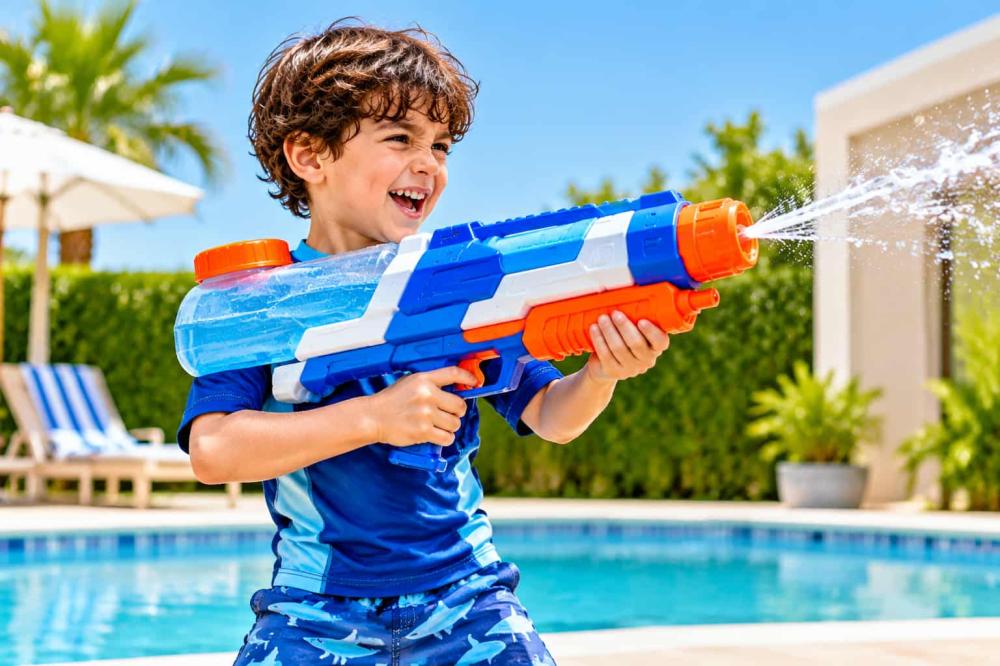
Hand-pump blasters with 650 ml to 2 L tanks, ranges of nearly 12 metres, plus hose-fed spinning sprayers for exciting ou...
When a Big Tank Earns Its Place
This page holds a small twin pack alongside tanks from six hundred and fifty millilitres up to two litres and seventy, and range climbs with the largest to about twelve metres. Those numbers give reach across a yard, and their price is weight your child carries through the whole session.
Work out the weight first: two litres of water sit near two kilos. An eight-year-old carries that one-armed for minutes, then rests it on a shoulder, then leaves it on the ground and returns to the smaller one.
Three Clear Sizes
This page divides into three sizes: a twin pack at a hundred and ninety-two millilitres each with six metres of range, a mid tank near a litre with two twisting streams, and a large tank past two litres reaching close to twelve metres.
The first suits two children at four and five, the second past six, and the third past eight. water guns remains the better stop for lighter mechanisms and faster filling.
Hand Pumping and the Rhythm of Play
A child pumps to build pressure and then releases, and that rhythm splits play into short cycles of effort and result. It differs from a continuous stream, which gives one long push until the tank empties at once.
Watch your child across two sessions. Some take to that rhythm and master it quickly, while others tire of the repetition and set it down after ten minutes.
Garden Sprayers With No Hand to Hold Them
Garden sprayers connect straight to a hose and spin a full circle, so a child jumps around them carrying nothing. One works from a foot platform that sends water up when stepped on, another spins continuously while water runs.
These suit under-fives, children who tire of pumping, and anyone playing alone. Put one in the energy and fun section or in the yard beside backyard pools to join both games in one session.
Blasters in Group Play
A large tank shows its value once four or more children play. Rounds run longer because nobody returns to the tap every two minutes, and the group spreads across more ground because the range allows it.
Set one rule before starting: whoever empties a tank walks to the filling point and does not fire from there. That rule turns chaos into a game with a start and an end.
Add our ball range halfway through to shift the pace. Water blasters like these suit parties and birthdays in the yard, since they keep a group of children busy under one rule.
What High Pressure Actually Means
Boxes carry phrases describing force, and high pressure is the most common of them. The phrase describes the mechanism rather than industrial force, since the pressure comes from a child's arm or a small motor and stays inside what a toy can hold.
Read the two printed numbers alone: tank capacity and range. Together they summarise what you need to know about a model, and the rest repeats across every box on the shelf.
Storage After Summer Ends
Empty the tank completely and leave it open a week in shade before closing it. Water stays in the internal tube after an apparent emptying, and that is what blocks the nozzle and ruins the rubber seal next season.
Rinse the nozzle in fresh water if play happened near the sea. The inflatable pieces in our float range need the opposite treatment, stored partly inflated rather than empty.
Gift or Household Piece
A twin pack makes a good gift because it solves the two-sibling problem in one box. A large single piece suits one child past eight who plays with neighbours across open ground.
Choose the small piece for a home without a wide yard. summer toys for kids and toddler pools hold alternatives that work in tighter space.
The Age a Big Tank Starts From
Parents ask what age starts on a large tank. Begin at six for the mid size and eight for the largest, and read the age printed on the listing itself, since it shifts between models.
They ask about leaks at the cap. Tighten until it seats and stop there, because over-tightening deforms the rubber seal and causes most leaks.
They ask what stays once summer ends. The pieces in large garden toys live in the yard all year, while blasters go into storage and return next season.


