
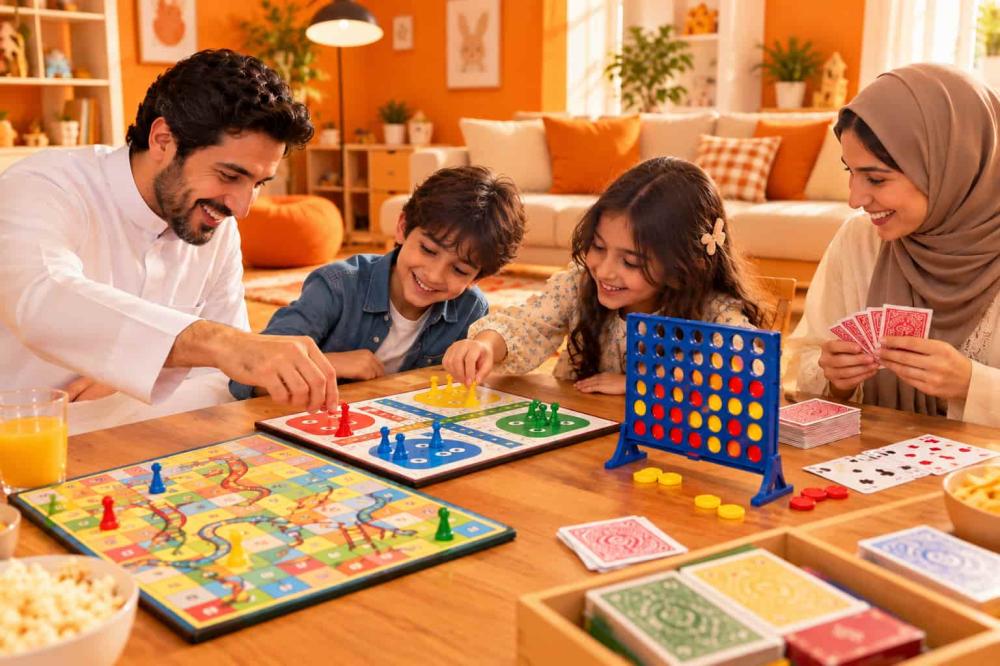
Group games are chosen by three questions: how many sit down, the age of the youngest, and the minutes you have. Cards e...
A father in the sitting room asks the same question every time: which game holds the whole family for a full hour without anyone walking off annoyed? The question is too good to answer with a single box, because your gathering is not four people alike in age, in patience, or in what entertains them. This whole section is built on that difference, so read what follows and then choose on the basis of your own house.
A group is not four people alike
When a Saudi family sits down, the circle holds a grandfather, a father, a seven-year-old, an eleven-year-old girl and maybe a guest who arrived after the round started, and each of them needs something different from the same box. The child wants his turn to come quickly, the adult wants a rule worth thinking about, and the guest wants to understand what is going on inside a minute with no long explanation. The game that works in your home is the one that gives all three of them something in the same round.
Three questions before buying: how many players, which ages, how much time
Before you open any box on this page, answer three questions on paper: how many people will play at your largest session, how old the youngest of them is, and how many minutes you have before the gathering breaks up. The first answer rules out half of what you see straight away, the second rules out anything labelled two years above your youngest, and the third separates a card box that finishes in a quarter of an hour from a large board that wants forty minutes.
Those three questions shorten the whole section for you, and they turn the choice into two clicks instead of an evening spent scrolling through pictures.
Games that carry the age gap between siblings
The gap between seven and eleven is wide in arithmetic and narrow in luck, which is why a game that brings in dice or a random card levels two siblings more than you would expect. Jackaroo, for instance, is played in partnerships, so you can pair your youngest with an older partner who guides his move, and he wins alongside him and learns from him without feeling the loss. Uno leans on what lands in your hand more than on counting, so the winning goes round the table fairly.
If the gap is much wider than that, the answer is two boxes rather than one, one for the shared session and one the older child plays alone or with a friend. The separate brain-game sections help here, so look through thinking games for boys or thinking games for girls depending on who is at home.
Cards are faster, boards run longer
This section mixes two kinds under one name, and you need the difference before buying because it is a difference in time rather than in price. A card box comes out of the bag, deals in thirty seconds and ends the round in ten or fifteen minutes, which suits the session whose length you cannot predict. A board wants a table, a layout, and marbles and pieces set in place, but it gives you a full session with a beginning, a peak and an ending your children remember. If cards alone are what you want, the section built for them is the card games section.
Jackaroo when the number is even
Jackaroo is played by four in two teams or six in three, and that arithmetic condition is the first thing to confirm before you buy the board. If there are three of you at home the session is short a partner and the game turns less enjoyable than it deserves, and if you are four or six it is among the best buys in this whole section. Our boards come in three sizes, some of them folding to fit a cupboard, and the detail sits in the Jackaroo section.
Uno in the sitting room and in the car
Uno is the answer when the session has no table at all, in the back seat, on the carpet, or on a desert trip between the tents. We carry several editions of it that differ in their action cards rather than in the game itself, so one adds a spinning disc and another builds on characters your children know from a series or a film. The price starts at nineteen riyal for a card pack and forty-five for a complete standalone box.
What spoils a session: long rules and small pieces
Two things kill most family sessions. The first is a rulebook that needs ten minutes of reading while everyone waits, and the second is small pieces, one of which goes missing and leaves the box incomplete a month later. Ask about the number of pieces, their size, and whether the box has a kept place for them, and check the box after every session before you close it. A third, less mentioned and more damaging, is the box that is an expansion rather than a game, bought and then found to need a base you do not own.
Arranging three different sessions at home
The first session is daily and short, after dinner, and wants a card box that opens and closes in a quarter of an hour. The second is weekly at the weekend and deserves a large board the whole family gathers around. The third is seasonal, at Eid, on travel and at invitations, and needs a box the guest who has never played it can follow. Buy one box for each of those three, and you will find you have covered the year with three rather than ten.
And if you want a wider choice for each of those three sessions, what is laid out in assorted board games arranges the boxes by the skill each one trains, which helps when you have several children at scattered ages.
How to widen a game instead of buying another
Before you buy a fourth box, look at what you already own, because much of it carries a change of rule that refreshes it for your children without a single riyal. A round of Uno with three cards in hand becomes a different game, and Jackaroo with a different partner each round reshuffles the alliances of the session entirely. If you do want to widen the shelf, the road runs to family group play, table games or creativity and learning, where the wider sections wait for players who have outgrown the first boxes.


