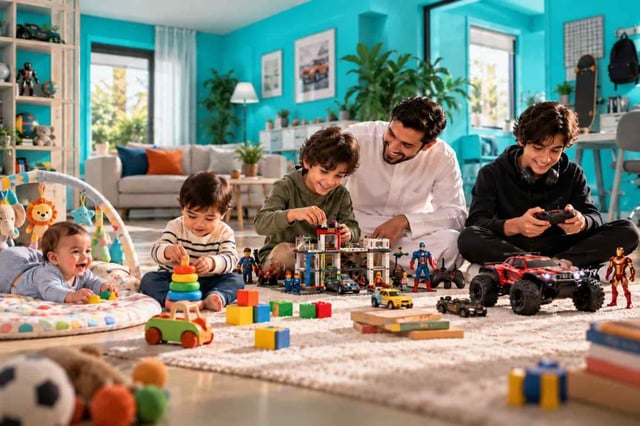

Blocks, squishy packs, pretend play sets, dolls and ride-ons across six age shelves from 1 to 10+. Pick her shelf or bro...
Two toys sit on one shelf at the same price with the same piece count. You buy the first, your daughter plays with it for three days, and it goes under the bed. You buy the second and she comes back to it after two months, then after four.
The difference never shows on the box or in the brand name. It shows in one question: does this toy land in the stage she is living now, or does it run a year ahead of her or a year behind?
1. What a girls' toy means on a shelf
The phrase describes a section in a shop rather than a trait in a child. Three concrete things separate this shelf from its neighbour: the licensed characters displayed on it, the colour range manufacturers favour, and the weight certain families carry in the mix, dolls and pretend play sets among them.
In practice that means you find wider choice from those families here, so you start your search on this shelf. It does not mean anything else is closed to her. A girl who pulls a box of blocks off another shelf should be bought that box without hesitation.
2. Six stations on an age ladder
- Up to one: grip, sound and texture. The toy fills a whole palm and answers back immediately.
- One to two: pulling, pushing and posting. She starts tying her action to its result.
- Three to four: pretend play and role taking, and the move from matching to working things out.
- Five to six: the session that lengthens, and the first game with rules she accepts.
- Seven to nine: long projects spanning more than one sitting, plus collecting and displaying.
- Ten and up: whatever does not look childish, and whatever gets shelved once finished.
Those boundaries stay approximate, since children run six months ahead or behind easily. The six stations are set out in full in the age map.
3. Why one toy lasts and another stops
A single-outcome toy ends the moment it is mastered. She assembles the picture once or twice, then loses any reason to open the box again.
A multi-path toy delivers something different every time: pieces that build many ways, or props that support roles with no natural end. That is where long life comes from.
None of which makes the first kind poor. A younger child needs mastery and reassuring repetition; an older one tires of it and hunts for a challenge.
4. Colour sells on the shelf, skill keeps it at home
She chooses with her eyes in the first minute, and her hand goes to the brightest box. We neither deny that nor fight it, and a colour she loves gets the box opened enthusiastically on day one.
What decides the second month is different: does the toy give her hands something to do? A lid that opens and closes, a piece that clips and unclips, a tool that carries something real from one place to another.
The split we suggest in our branches: you settle the family and the stage, she settles the colour and the character between two options you already filtered.
5. Blocks: the piece that crosses four stages
- In the second year she stacks two pieces and knocks them down, which is complete play at that age.
- At three she builds with no plan and names the result afterwards.
- At five she plans first and then builds, and gets cross when it collapses.
- Past seven she follows illustrated steps until the model is finished.
Start with pieces that fill a palm before age two, and move to smaller ones when you see her thumb and forefinger working together.
6. Squishies and surprise packs, and where they belong
Surprise packs and squishies run on one thing: the moment of opening. The pleasure lives in the unknown rather than in the item, which is why it fades soon after the wrapper comes off.
That does not cancel their value. They work as a small gift between occasions, they work on a journey or in a waiting room, and they work as a reward.
What they do not work as is the largest purchase in an order. Make them the second item beside something that lasts.
7. What mothers ask us at the girls' shelf
Should I follow the printed age? Read it as an estimate rather than a rule, and watch her hand instead. A child holding a matchbox-sized piece between thumb and forefinger is ready for smaller parts whatever her age.
What do I buy for a girl who has everything? Ask what she returns to daily rather than what she owns. Interest is read from repetition, and the method sits in what your daughter loves.
Do toys pass between sisters? Anything resting on a skill passes down. Anything resting on one particular character rarely does.
8. Three minutes before you pay
- Set the stage from what she does, not from her birth date.
- Ask how many different paths the toy offers. One path means one week.
- Check the smallest piece against the grip she has today.
- Give her the last decision between two, rather than the first between twenty.
What survives the first month
Buy for her stage rather than her printed age, and favour multi-path toys over single-outcome ones. Keep surprise packs as the second item rather than the first, and leave colour and character to her once you have settled the family.
For the first year specifically, start at our newborn range. For a girl past seven who wants a project spanning more than one sitting, see the long-project shelf.