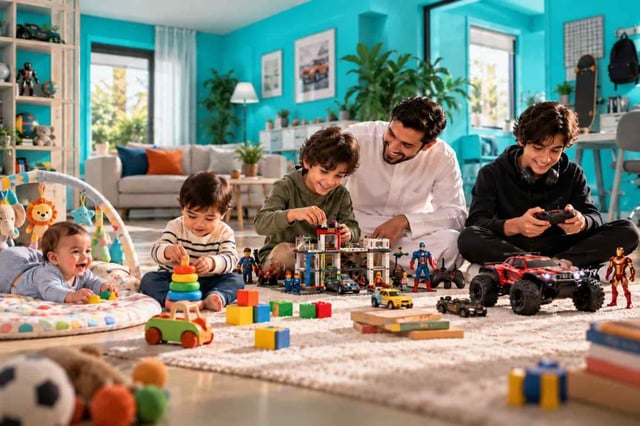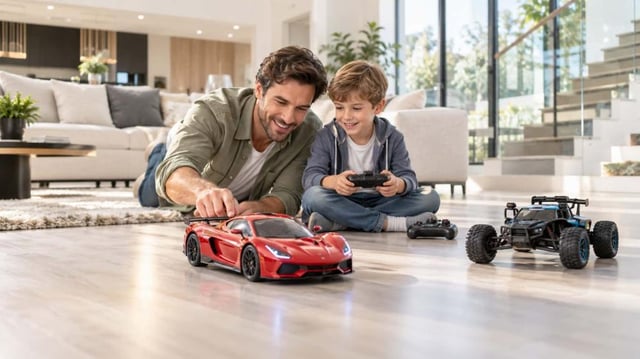

Toy cars that run on remote control, friction or a simple hand push, from age two upward. How to choose between them at...
Before a child ever picks up a controller, he does one thing: he takes the car in his hand and pushes it across the carpet. A two year old does it and a ten year old does it, then the older one returns to the remote while the younger one stays with his hand.
That first movement is the most honest guide to what suits your child. Toy cars fall into three families based on what moves them, and choosing starts there not from the shape or the brand.
1. Three ways a car moves
Everything in this section runs on one of three:
- Hand push. A metal or plastic car with no motor. It travels as far as the push carries it, works on any surface, needs no battery and has nothing to break.
- Friction. The child pulls it back or shoves it hard along the floor, storing that motion in an internal flywheel, then it runs a metre or two on its own. Again, no battery.
- Remote control. A handset in his hand and the car answers. This is the only family that needs batteries, charging and room to move.
The difference is not price but stage. A child moves from the first to the third over years, and does not leap.
2. Age two to four: the hand before the handset
At this age a car is a prop for imaginative play; nobody is driving anything yet. The child makes the engine noise with his mouth, builds a road out of cushions and flips the car over to watch the wheels spin.
So start with a large body on wide wheels that his whole palm can grip. The diggers and construction vehicles serve this age best, because their moving parts give small hands something to do: raise the bed, swing the arm, tip the load.
Avoid small detachable pieces at this stage, and cars that need a fiddly button to switch on.
3. Age five to seven: the first remote
This is where a child can reliably connect the movement of his thumb to the movement of a car in front of him. It is a trained skill, not an innate one, and it shows within a week: on day one he hits everything, and by day seven he circles a chair without stopping.
A first remote should be simple: forward, back, left, right, with no extra functions. The remote control car section carries that level and everything above it, and the age printed on the box settles which one is yours.
4. From eight upward: speed and detail
What the child asks for changes completely. He starts naming the car, comparing it to the real thing, weighing one model against another and wanting more speed.
This is the stage for race cars with their sporty detailing and scale models, and it is where diecast pieces meant for collecting as much as playing, begin to make sense.
5. Space decides more than you think
Pace out the longest corridor in your home and count. A remote car needs length rather than width, and anything under four metres means your child spends his time reversing.
If the house is tight, the answer is not to give up the remote but to change the shape of the play. Toy car tracks give a closed circuit that works in a metre square, and the car laps it endlessly.
6. Your floor decides the wheel
Thick carpet swallows low bodies, and polished marble makes rubber wheels slide. The rule is simple: the higher the car sits and the bigger its wheels, the more surfaces it will handle.
If play happens in the yard or on outdoor tiles, look for wide rubber wheels and a suspension system, which is where the toy trucks section is strongest.
7. Batteries: included and separate
Some cars arrive with a rechargeable pack and a cable, others need cells you buy. More importantly, the handset itself usually needs its own batteries, and those are the ones everyone forgets.
So read the battery line twice: once for the car and once for the controller. Buy a spare set with the toy rather than a week later.
8. What separates a toy car from a car a child rides
The two get confused constantly, and the gap is total. A toy car is held in the hand or steered by a handset, weighs grams, and lives in a bedroom.
Ride-on cars for children, by contrast, carry the child's weight, and come with a seat, a belt, a motor and a large battery. Their place is a yard or a wide driveway. If you are looking for something your child sits inside, you are in the wrong section.
9. When he tires of cars
It happens, and it does not mean the toy failed. Most children go through a car phase lasting a year or two and then move on.
The natural next step shares the control principle rather than the shape: planes and drones offer the same pleasure of steering at a distance with a third dimension added. Plenty of children who started with a remote car ended up there.
Before you choose how it moves
Ask three questions in order: how old is he, how many metres does he have, and what is the floor made of. The first picks the family, the second picks the size, the third picks the wheel. Leave the shape and the colour to him; he knows what he likes.