
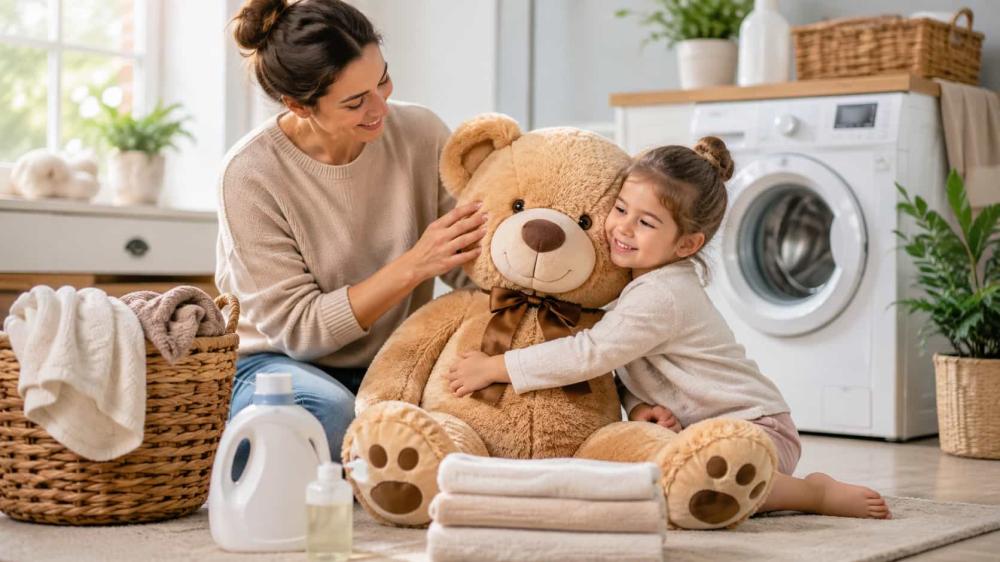
Large teddy bears and stuffed dolls in different fabrics and fillings, each behaving differently after a first wash. Her...
The teddy comes out of the machine looking smaller. The fur has matted and gone coarse, the filling has shifted to one side so the head leans, and the child holds it and says it is not her teddy.
Nothing strange happened. The first wash reveals what you actually bought, and the fabric it carries decides whether the teddy lasts years or a season.
That reading starts at the small label sewn into the side seam, not at the shape.
Outer fur: three types you can feel by hand
- Short dense pile. Short close fibres, nearest to velvet. The least prone to matting and the easiest to clean, and the right choice for a teddy living with a young child.
- Long soft pile. Long fibres that move under your hand. The best looking and the fastest to mat, needing a brush after every wash.
- Curly pile. Small twisted loops resembling sheep's wool. It hides dirt and resists matting, but traps dust inside the loops.
The hand test beats any description: run your palm against the direction of the fur and let go. If the fibres spring back on their own, the fabric is good. If they stay flat, it will mat after the first wash.
The filling: what you cannot see decides everything
- Hollow polyester fibre. The commonest and lightest, springs back after pressure and dries quickly. The right filling for large sizes because it keeps them light.
- Small beads. They give a pleasant weighted feel and let the teddy sit upright. But they shift during washing and do not settle back easily.
- Mixed filling. Fibre in the body and beads in the base, so it sits steady and stays light. The best pick for a teddy that stands in a corner.
Poor filling shows by hand before any wash: press the belly with your thumb and release. If the dent stays and the space does not fill, the filling is either thin or already clumped.
Three details to check before you pay
- The eyes. Embroidered thread cannot be pulled off; fitted plastic can loosen with repeated tugging. Embroidered is the rule for under-threes.
- The side seam. Pull both sides of the stitching gently. Close stitches open no gap; wide ones are the first place filling escapes.
- Attachments. Ribbons, buttons and plastic noses are all separate pieces. The fewer there are, the longer the teddy lasts and the less there is to worry about.
Washing: what works and what ruins it
Most teddies survive washing. The mistake lies in the method rather than the washing itself.
Before: shut it inside a laundry bag or a pillowcase. The bag stops the fur rubbing against the drum, which is the leading cause of matting.
During: cold water, gentle cycle, low spin. Hot water shrinks synthetic fibres and turns the fur coarse permanently.
After: keep it out of the tumble dryer. Hang it by the ears or lay it on a towel in the shade, turning it every couple of hours so the filling redistributes while damp.
The touch that makes it new again: brush it with a soft hairbrush while half dry, in short strokes with the direction of the fur. That alone separates a teddy that looks used from one that looks like the day you bought it.
What to do between washes
A teddy does not need a full wash every time, and frequent washing is itself what shortens its life.
Wipe the mark alone with a damp cloth and a little mild soap, then dry with a towel by pressing rather than rubbing. Every fortnight, shake the dust out in the air and brush the fur through.
In humid weather, never leave a teddy in a closed unventilated space; the fur traps moisture and develops a smell that is hard to shift.
What parents complain about after two months
Three complaints repeat, and each has a cause visible before purchase if you look for it.
- "It went coarse." Washed hot or without a bag. Long pile shows it first.
- "The head leans." Bead filling shifted and never settled back. The fix is massaging the neck by hand while damp to redistribute it.
- "It smells different." Dried in a closed space, or still damp inside. Large plush needs a full day rather than a few hours.
All three are care mistakes rather than product faults, and avoiding them costs less than replacing the teddy.
Sizes: which one suits which spot
Size in plush is a space decision rather than a personal preference.
Small up to twenty centimetres travels in a bag and washes easily. Medium up to forty sleeps on the bed and takes long hugging. Large above that sits in a corner, and needs a big shaded drying area for a full day after every wash.
Before buying large, ask one question: where will it dry? Anyone without a shaded space that fits it is buying trouble rather than a toy. Smaller sizes sit in small kids dolls.
Plush is for every age, not babies alone
Many people assume a teddy is a baby's toy. In truth its use changes with age and never stops.
A baby explores it with hands and mouth, a three-year-old talks to it and casts it in stories, a seven-year-old collects and arranges them on a shelf. Anyone after characters to collect rather than hold will find play figures and animal figures.
Every type of doll sits in the dolls and characters range, and the small clip-on pieces in kids keychains.
What survives the first wash
Read the label before the shape: short dense fur, fibre filling and embroidered eyes give you a teddy that lasts years. Wash cold inside a laundry bag, dry in the shade, and brush it while half dry.
Wipe marks between washes instead of washing fully, because repeated washing ages plush faster than use does.
And if you are buying a gift without knowing the child's preference, a medium size in short fur is the safest call. What completes an existing doll sits in doll furniture and prams, and a whole scene in the dollhouse section.