
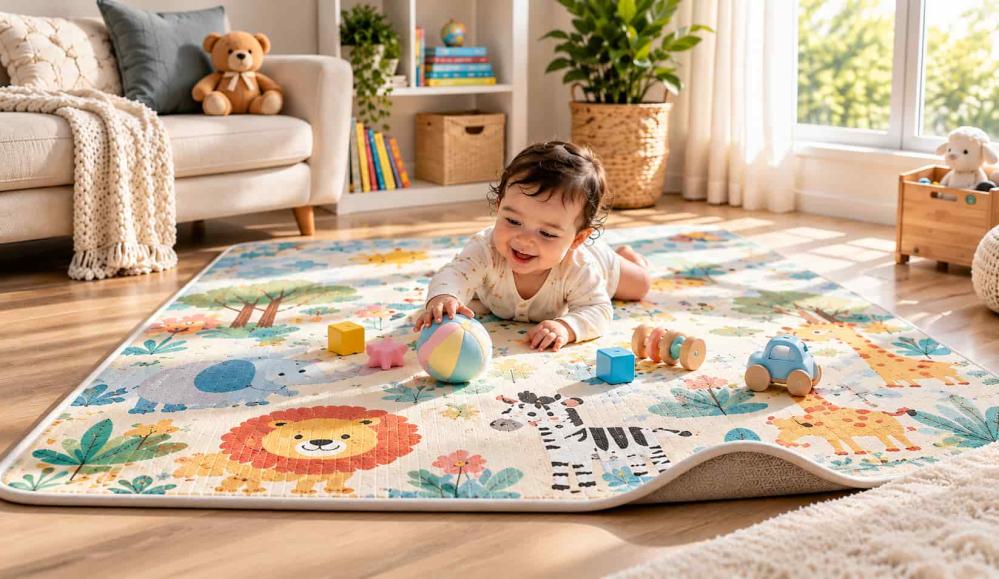
Printed play mats with a soft face, activity gyms with rings, a mirror and a piano panel, infant mats, and foam tiles a...
Sit on a tiled floor beside a baby for twenty minutes and you learn something no product page mentions: the tile is cold, and your back notices before he does. Most parents read a mat as a thing bought for the child alone, yet it quietly solves two problems at once, giving your baby the clean surface he needs to roll on freely and giving whoever sits with him a bearable quarter of an hour on the ground.
We arranged this section on exactly that basis, so you will find mats that stay spread in one spot all year, mats that fold away in a minute and travel with you to a grandparent's house, and tiles laid piece by piece that grow with the room each time its furniture moves.
One Name, Four Products at Baby Story
Four separate products share this one shelf label and behave nothing alike in daily use, and the photographs blur them together because every mat is shot the same way, spread flat on a floor. The first arrives as a printed blanket with a single soft face that you lay in the living room and leave there, while the second is an activity gym with two crossing arches from which toys hang directly above your baby's face.
The third is foam flooring cut into interlocking tiles, so you cover precisely the area you intend, whereas the fourth is a printed rug showing a street map or a whole city that your child drives toy cars across after his third year. Read the listing and its dimensions before you order, because an attractive print is the single commonest reason parents end up with the wrong type.
The Size Your Child's Room Can Take
Measure the floor you have in mind before you look at any print, because size is the one decision that cannot be fixed after the parcel arrives at your door.
Large living-room mats run roughly a metre and a half by a metre twenty, and that span carries a baby through rolling, crawling and sitting in three consecutive stages, while an activity gym needs far less since your child stays near its centre under the arches.
Foam flooring, though, is counted by the square metre rather than by the piece, as one tile covers a metre square at two centimetres thick and you add or subtract tiles to suit the room. Leave enough clearance around the edge for furniture, so that no corner folds under a chair leg and trips your child while he is running.
Thickness: One Centimetre or Two
Thickness decides three things parents notice within a fortnight: how cold the tile feels in winter, how loud a landing sounds when your child drops, and how long the mat itself lasts before it goes slack. A thin mat gives you a sleeping surface that folds easily and fits a travel bag, and it serves the newborn who lies on his back and does not yet move much.
Thick foam gives you a layer that absorbs the first seated thump and stops cold rising from the floor into your child, and whoever has just started pulling himself upright needs it more than anyone, since he lands on his bottom dozens of times a day. Press the surface with your thumb when it arrives, because a good mat springs back under your hand instead of staying dented where you pushed.
Newborn to Three: How the Use Changes
A newborn uses the mat for a few short spells on his tummy each day, and those few minutes are where the strengthening of his neck and shoulders begins, long before he learns to sit.
At six months he uses it as room to roll and to reach sideways for whatever he can see, and at a year it becomes the ground he crawls across and tries to stand up at the edge of, attempt after attempt.
After two the mat shifts from developmental ground to play ground, so cars and blocks appear on it while the hanging rings disappear. You will find what suits each of those stages in the newborn section and among motor skills toys, alongside the active play section for children past crawling.
Activity Gyms: Piano, Mirror and Hanging Toys
An activity gym adds to a mat what a plain blanket never will: two arches meeting above your child, strung with rings, a mirror and a rattle, and on some models a piano panel at his feet that sounds a note when he kicks it, so he kicks again. What you are really buying here is the reason your baby stays contentedly on his back, and those are the hardest minutes of the day in a great many homes.
Watch your child on the same gym for a fortnight, because once he pulls a ring down, lets it go and reaches for it again, he has moved from watching to deliberate grasping. Our musical toys carry that idea further, and so do our baby rockers in the hours when your child wants movement while seated.
Foam Tiles, and When They Beat a Mat
Choose foam if the whole room is play space, if the tile floor turns cold enough in winter that you feel it through your palm, or if you want a surface you wipe with a damp cloth and dry within a few minutes. Foam wins in three clear situations: an area larger than any ready-made mat, a room whose furniture changes every year, and a child who stands and falls all day long. Fabric mats keep one advantage that foam does not have and never will, since they fold in a single minute and come with you in a bag to any house you visit.
Play Mat Brands at Baby Story
Names parents already know sit together in this section: Fisher-Price with its wide printed mats carrying Little People faces, and Huanger with activity gyms and piano mats that start from birth.
Beside those names stand plain interlocking foam tiles with no brand on the box at all, and they are the widest thing in the section when measured by area covered. Pick by age and size first and by name second, because a brand tells you about the material and the printing while saying nothing about whether the dimensions fit your room.
Washing, Folding and Storage
Ask how a mat is cleaned before you buy it, since that single answer decides its working life in your house more than its price and its brand put together. Foam and coated mats wipe down with a damp cloth and mild soap and then air-dry in under an hour, whereas cotton mats go into the machine on a cold cycle and should then hang flat so no permanent crease sets across the middle. Fold the mat along the same line every time, because reversing the fold breaks down the inner layer and opens a pale streak through it over the months. Store it flat under a bed if the space exists, which is far better than leaving it rolled up in a corner of a storeroom for a season.
Mistakes That Spoil a Mat Choice
Parents fell into the same mistakes often enough that we now watch for them. They buy for the print and receive a lovely mat smaller than the floor it was meant for, they buy thick foam for a newborn who cannot sit yet and pay for depth that matters a full year from now, or they buy thin for a toddler who stands and then hear every landing from the next room.
Reverse the order completely: floor area first, then your child's age, then thickness, then the print last of all. Ask our team before you order if the choice still feels close between two types, and we will match a mat to your room and your child's stage, or point you to the bath and play section if what you want is a mat for bath time.


