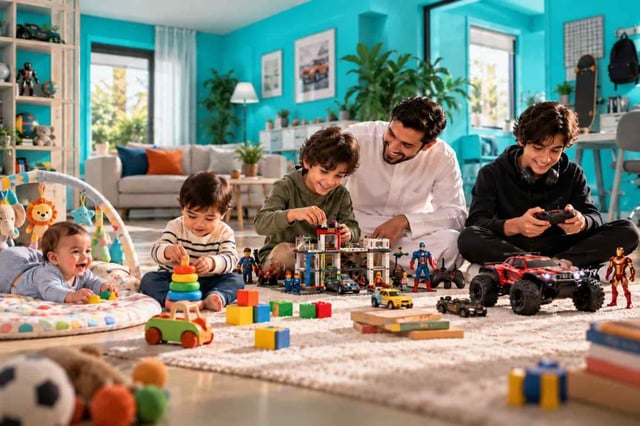

Six age shelves from cot to teen: crawl tunnels, blocks, bowling and remote cars. See why boys drop toys they chose, and...
The toy he pushed for over three days now sits in a box under the bed. He wanted it honestly, opened it eagerly, and played hard with it for a full week. Then he stopped.
The gap is not in the toy. What a child requests comes from a scene he saw, and what he uses comes from what his hand can do today. Between the two sits a distance the father pays for twice: once in price, and once in a small disappointment on his son's face.
What He Asks For and What He Reaches For
The request comes from the image. He sees something move fast in another boy's hands and wants that speed. Holding it, he finds it needs a skill he has not built, a floor the house does not have, or a partner who is asleep.
Use comes from ability. The piece he returns to daily is the one he succeeds at on the second try and fails at on the tenth. Total success bores. Total failure stings.
Three Reasons Behind the Abandoned Shelf
- The silent age gap: a box marked six in the hands of a four-year-old still works, but at half its pleasure. The parts are finer than his grip, so he withdraws without complaining.
- The single-outcome toy: it ends when he wins. After the win there is nothing left in it.
- The need for a partner: many toys assume two players. A house with one boy plays alone most of the day.
The Piece That Survives Being Thrown
Throwing is not aggression. It is testing. Between one and three a boy checks objects by dropping them, measuring sound and bounce. What survives is solid, round-edged, with no thin protruding parts. Buy on that first and shape second.
Look at wall thickness, not weight. Press an edge with your thumb: what flexes under pressure splits under a fall.
Cot to Teenager in Six Stops
Our tree runs on six stops, each its own shelf. The first covers year one: crawl tunnels, barriers, foam flooring. The second, one to two: chunky parts a whole palm can close on. The third, three to four: first assembly in steps. The fourth, five to six: simple rules and waiting a turn. The fifth, seven to nine: projects that outlast one sitting. The sixth, past ten.
Boys skip stops. A five-year-old builds kits marked seven; a seven-year-old returns to chunky blocks. That is why boys toys by age sits there as a map, and the boys interest sections beside it for parents who know the leaning but not the shelf.
Open Toys and Closed Toys
A closed toy has one outcome: a picture that assembles, a button that plays a clip. It teaches something specific quickly, then stops.
An open toy gives a different result every time: blocks that build a thousand ways, roles acted with no script. It lasts months, and it is the hardest thing for a father to judge in a shop, because its value never shows on the box.
Both belong at home. Closed builds mastery and confidence, open builds duration. Trouble starts when the shelf fills with one kind.
Floor Bowling and Why It Comes Back
A floor bowling set is among the most repeated items in homes with a boy between three and seven. The reason is plain: the result is instant and visible. Pins fall or stand, and nobody has to judge.
It also grows. At three he rolls from a metre and celebrates one pin. At six he moves the line back, counts points and invents rules. Same set, different distance.
When Brothers Share the Same Toy
Toys for a three-year-old differ from toys for an eight-year-old, but the shareable pieces are few and known: blocks, bowling, simple board games. Buy those to the older boy's size and the younger catches up. The newborn range does not share; each age keeps its shelf.
Once the gap reaches three years or more, separate them. The older one decides his toy became babyish and drops it, and the younger breaks what he cannot read.
The Mistake That Repeats on a First Purchase
The commonest error on a first toy is buying for a future age. A father wants it to last, so he takes a size two years ahead. The boy cannot manage it now, and by the time he can, familiarity has drained it. Buy for today and leave the early teen shelf until it arrives.
The second error is three middling toys instead of one that fits. A crowded shelf scatters attention, and nothing gets deep enough to matter.
What Lasts in His Hands
Three questions before you pay. Can he operate it alone today? Does it have more than one outcome? Will it find a fixed place in the house? Three yeses buy a toy that lasts.
The shelf is crowded and the differences do not show on the packaging. They show a month later, when you look at where the toy stands: in his hands, or under the bed.