Dolls, plush teddies, pocket figures, surprise boxes and dollhouses, in sizes from a pocket to a hug. Here is what separ...
A child stands at the doll shelf, points, and says "that one". The finger covers twenty things at once: a doll with long hair, a teddy the size of her arm, a sealed box nobody can see into, and something small hanging from a metal ring.
The parent is asking an entirely different question: which one of these?
The shelf looks like one family. It is five. Each does something different for a child, suits a different age, and lives in the house differently. Here is the map.
Five families on one shelf
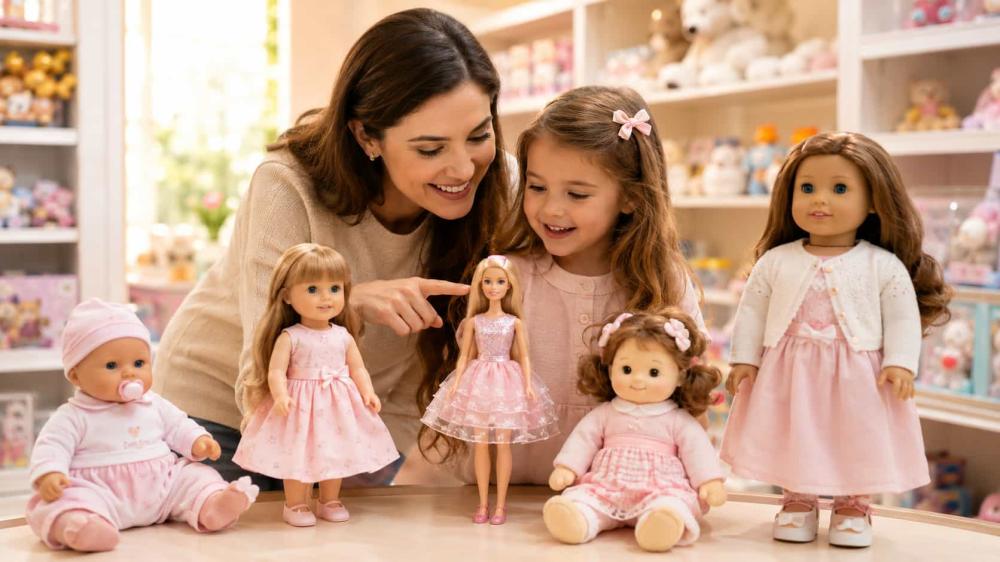
- The classic doll. A human-featured character that dresses, undresses, sleeps and rides a pram. Its centre is care.
- Plush and teddies. A soft body made for holding. Its centre is reassurance rather than play.
- Pocket dolls. A palm-sized piece that travels in a pocket or a bag. Its centre is portable company.
- Surprises and sealed boxes. You cannot know the contents until you open it. Its centre is anticipation.
- Houses and accessories. Never bought alone; they complete a doll that already exists.
Most of the confusion at the shelf comes from mixing two families, not two products.
The classic doll: a caring toy, not an ornament
A child playing with a doll rehearses a role she does not hold in real life: the one who looks after someone else. She feeds it, puts it to bed, changes its clothes, tells it off, and repeats back to it what adults say to her.
That is why dolls usually arrive between two and three, as pretend play begins, and stay for years afterwards.
What parents should watch: hair length decides the lifespan of the toy more than anything else. Long hair tangles within weeks in the hands of a young child; short or fixed hair lasts far longer.
Plush and teddies: the hugging family
A child does not so much play with this family as live alongside it. The teddy sleeps in the bed, travels in the bag, and shows up for the crying. Its job is emotional before it is entertaining.
Size is the decision here: small for bags and travel, medium for the bed, large for a corner and a photograph. Every size sits in plush dolls.
Pocket dolls: small enough to travel
A piece seven or eight centimetres tall fits a pocket or a pencil case. Its pleasure is not long play but constant presence: a child takes it out in the car and in a waiting room, then puts it back.
This family suits the child who bores quickly, because it asks for no space, no time and no tidying. It lives in kids dolls, and the clip-on versions sit in doll keychains.
Surprises: the joy of opening
A sealed box sells something other than its contents. The real pleasure lives in the minute before opening; afterwards the child moves on to the character itself.
Which is why this family works as a small repeated gift far better than as a main toy. The detail sits in surprise boxes.
Houses and accessories: what comes after the doll
These two are not where you start. You buy them once a doll exists and the child is genuinely attached to it.
dollhouses turn play from a single object into a whole scene with rooms and characters. Meanwhile doll accessories extend the life of the doll you already have instead of buying another.
The age ladder at Baby Story
- One to two. Soft plush with no small parts, in a size a child lifts with one hand.
- Two to four. The first doll, with clothes that come off easily, since fingers are still learning.
- Four to six. Houses and accessories, where play becomes a scene rather than an object.
- Six and up. Surprises, collecting and trading with friends, keychains alongside.
These ages overlap widely, and a child may run a family ahead or a family behind.
Three numbers to read before you pay
The shelf shows you a shape. The box shows you numbers, and three of them genuinely matter:
- The age on the box. It describes the size of the parts inside rather than the cleverness of the child. Small parts are the first reason anything is kept away from under-threes.
- Height in centimetres. The number parents skip and then regret. A thirty-centimetre doll behaves nothing like a fifteen-centimetre one for carrying, storing, or buying clothes later.
- Piece count. A forty-piece set delights for a week and loses half of itself in a month. Fewer pieces last longer in a house with younger siblings.
One quick test in store: hold the piece in one hand the way your child will hold it. If it feels heavy to you, it is twice as heavy to her.
What we hear at the doll shelf
My daughter owns ten dolls and plays with one. Why?
Because the number is not the problem. A child bonds with one piece and the rest becomes decoration. Do not buy a tenth; buy something that serves the one she loves — clothes, a bed, a pram.
Are dolls only for girls?
No. Plush characters and figures get just as much play from boys, and plenty of them sit in character figures and dinosaur figures.
My child is frightened of one particular doll.
It happens, especially with very realistic features or oversized eyes. Move it out of sight without discussion and try simpler features.
The route to the right shelf
Start from the family, not the piece. Ask whether your child wants something to hold, a character to look after, a companion to carry, or a box to open. That answer cuts the shelf from twenty to three.
Then pick size by where the play happens, hair length by the age of the child, and buy no house and no accessory until you know which doll she loves.