
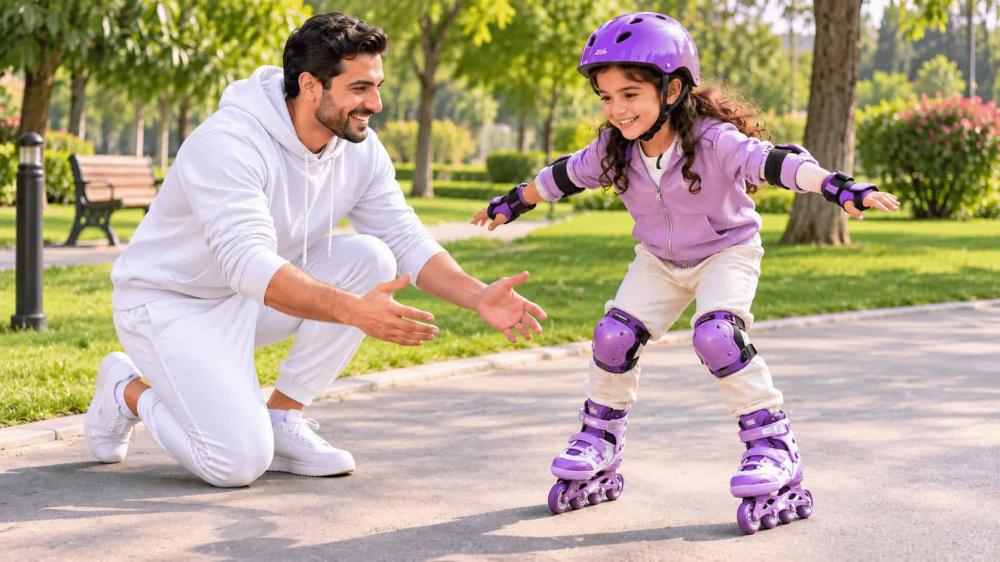
The first push comes fourth, never first. Three steps taken on grass save weeks of falling, and they turn the first real...
The Hand Grabs the Wall Before Anything Else
Your child stands on skates for the first time and his feet move before he tells them to, so he reaches for the nearest wall and holds on. That moment repeats with every child at any age, and it signals not fear but a body hunting for a fixed point.
Teaching a child to skate starts from that fixed point rather than from the push. Give him something steady to hold through the first steps, then withdraw it gradually until he lets go on his own.
The First Step Happens on Grass
Put the skates on and let your child stand on grass or a thick rug for the first ten minutes of the opening session. Grass stops the wheels from rolling, so he feels the weight of the boot and his new balance without anything sliding out from under him.
That step runs ten minutes and no more, and it saves your child a week of repeated falls on tiles. Move to a smooth surface afterwards, by which time he is already standing steady.
Falling Is Practised Before It Happens
Teach your child how to fall before you teach him how to skate. Ask him to drop to his knees on the grass ten times in a row, so his body learns the route to the ground and stops fearing it.
After that drill a fall turns from a surprise into a movement he knows. You notice that he gets up and carries on instead of crying and asking to take the boots off.
The Duck Walk and the First Push
Ask your child to turn his feet outward and take short steps like a duck. That walk shifts his weight from foot to foot, which is exactly the movement he will use to push, except he learns it slowly enough to correct himself.
The first push then arrives by itself: he drives with one foot and lets the other glide. Do not ask him for it, because it shows up on the second or third day once his body settles into shifting weight.
Stopping Is the Lesson Parents Postpone
Most parents teach movement and forget stopping, so the child finds himself rolling with no way to slow down. Teach him to open his feet and drop his hips to slow down, and to lean inward until he curves to a halt. Drill it before he reaches any speed at all.
Make stopping a game at first: say an agreed word and stop alongside him. Handled this way, stopping becomes a quick response rather than an instruction he has to think through.
The Boot That Makes Learning Easier
the skate range with four wheels in two rows make learning easier than a single line does, because the wider base gives more steadiness through the first weeks. A child loses confidence fast if he starts on a boot that tips under him.
Pick the adjustable size where your child sits at the start of the range, and make sure he can fasten it himself. A child who puts his own boots on goes out more often than a child who waits for you.
The Place That Halves the Journey
The surface makes a difference measured in weeks. Level tiles free of gravel make everything easier, while rough asphalt slows the wheel and tires your child for a reason he cannot name. Walk the spot yourself before taking him there.
Look for a stretch about ten metres long with no slope. That much carries the entire first four weeks, and he needs nothing larger before he masters stopping. energy burning toys and big garden toys fill the same yard between sessions, when his body wants a rest from standing on wheels.
How Long a Session and How Many a Week
Twenty minutes is enough for one session at the start, and it ends before your child tires rather than after. Learning tracks mood more closely than it tracks hours, and a child who finishes happy asks for it again tomorrow.
Make it three sessions a week instead of one long one. The body consolidates between sessions, so you find him better next time without having practised in between.
After Skating: Where Your Child Goes Next
A child who has mastered balance moves on to the scooter section and the bicycle section easily, because the core skill stays the same and only the tool changes. You notice he learns the second one in days rather than weeks.
small sports games covers the hot and rainy days that keep him indoors, and movement toys suits the younger siblings who watch him and want to copy. Pick for each age what matches its balance today.


