Two rules fix the board: a light square on your right, and the queen standing on her own colour. Plus the six names and...
You find yourself in front of a board with a child asking where the knight goes. Most fathers know the game incompletely and hesitate over the answer, so the first lesson comes out muddled and your son spends a full year setting the pieces up wrongly. Laying out a board and naming the pieces are not hard, and in this explanation you will find the correct arrangement and the move of every piece in one line, learnable alongside your son in a single sitting.
The board before the pieces
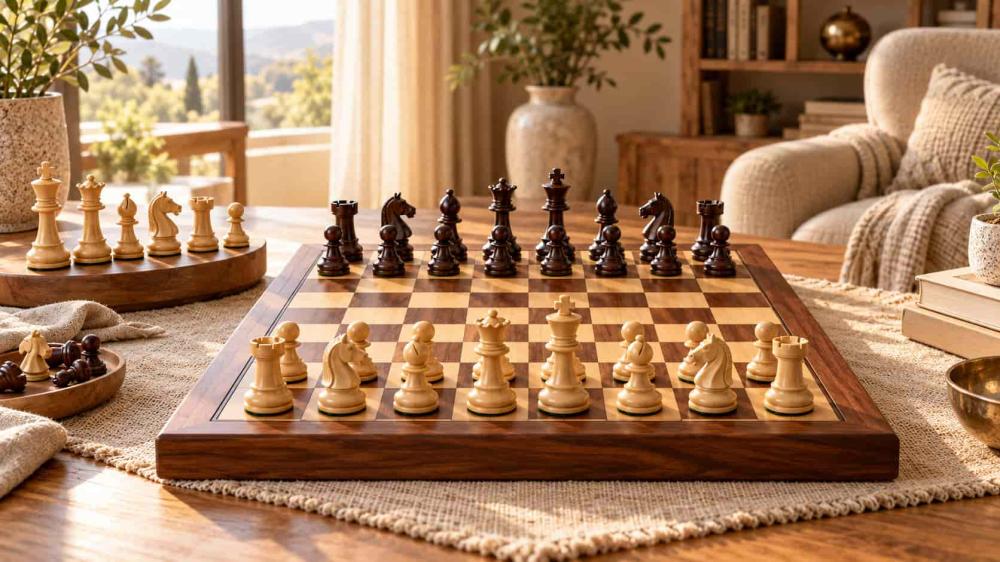
Open the board between the players, then look at the corner on your right and make sure it is a light square, because that is the first rule of the setup and what a beginner most often gets wrong. The board is sixty-four squares in eight rows and eight columns, and each player fills the two rows nearest them with their sixteen pieces. If you sit down with a dark square on your right, you are playing on a reversed board, and everything after that goes out of order.
The six names
Each player has sixteen pieces of six kinds: one king, one queen, two rooks, two bishops, two knights and eight pawns. Learn those six by name with your son before any move, because the whole of the rules rests on telling them apart. You will also find different local names in some sets, so agree on one name for each piece in your own house.
The correct setup and who stands where
Start from the corners: a rook in each corner, a knight beside each rook, a bishop beside each knight, and two squares left in the middle for the king and queen. Then place the eight pawns across the whole row in front of them with no exception, so your child has a full row shielding him. The same arrangement faces him on the other side, so rook faces rook and knight faces knight in every column.
The queen on her own colour
This is the rule that settles the argument over the two middle squares: the queen stands on the square of her own colour, so the white queen takes the light square and the black queen the dark one, and the king stands beside her on what remains. Learn that one sentence and you will set the pieces correctly every time without checking a book. It is the most common mistake parents make when teaching, swapping king and queen and throwing the game out from its start.
Every move in one line
The rook moves along rows and columns any number of squares, the bishop moves on the diagonals any number, and the queen combines rook and bishop, making her the strongest piece on the board. The knight moves in an L, two squares then one at a right angle, and it alone jumps over other pieces. The king moves one square in any direction, and the pawn advances one square and captures diagonally, with two squares allowed on its first move only.
The piece names in Arabic
You need these if your son plays with family or reads an Arabic book: malik for king, wazir or malika for queen, rukh for rook, feel for bishop, hisan for knight and baidaq for pawn. Learn them with him, since they are what he will hear at any Arabic table. Note that the bishop is called the elephant in Arabic, which surprises anyone coming from English first.
Three special rules
Three rules sit outside the movement of the pieces, and your son needs them before his tenth game. The first is castling, a single move that shifts the king two squares towards a rook and brings that rook to the far side of him, conditional on neither having moved and the squares between them being empty. The second is pawn promotion: a pawn reaching the far end becomes a queen, or any piece you choose. The third is capturing en passant, taking an opponent's pawn that has just advanced two squares past yours.
A child's first five moves
Teach your son one rule at the start: open the centre, bring out a knight and a bishop, and castle your king. So a centre pawn two squares, then a knight, then a bishop, then castling, then the other knight, which is five moves that serve in every game and ask for no memorised openings. With them your son comes out of the first five minutes in a sound position, learning to play rather than to memorise, and that is what keeps the game liked.
When the game ends
A game ends in three ways: checkmate, where the king is surrounded with no escape and his owner loses; stalemate, where a player has no legal move while his king is not threatened; and a draw by agreement or by the same position repeating three times. Explain the difference between the first two to your son, since most children assume that having no move is a loss when it is a draw. Once he understands all of this, the boards and sets are in chess, what builds thinking alongside them is in focus games, the boys thinking games section and the girls thinking games section, and the family session sits in group games.