
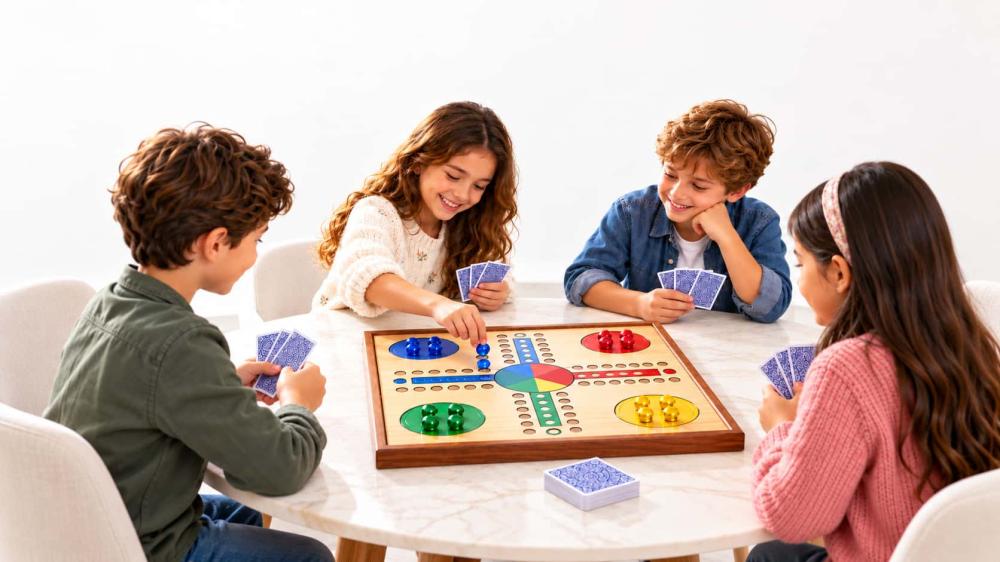
The rules are shorter than they look: five cards with special meaning, one condition for leaving home, and a win for the...
The group sits around the board, the cards are dealt, and someone asks the question of every first session: how do we start? The rules of Jackaroo are not as long as the booklet makes you fear, since at their core they are three rules you learn in a single turn, and the rest is detail that clears up as you play. This explanation walks you from laying out the board to the last marble coming home.
What you need before the first turn
You need three things together: the board, sixteen marbles in four colours with four per player, and the pack of cards that comes with the box, fifty-six of them. You also need an even number of players: four in two teams or six in three, and each player sits opposite their partner rather than beside them. Anyone missing one of those three will find the complete sets in the Jackaroo aisle.
Laying out the board and the marbles
Each player has four squares on the board called home, and a marble leaves it only on a particular card, and at the far end each has a run where the marbles finally come in. So place your four marbles in your home, put the cards face down in the middle of the board, and deal four cards to each player in the first round. Then begin with the player to the dealer's right and move clockwise for the whole round.
The cards and what each one means
Most cards move a marble by their number, so an eight moves eight squares and a ten moves ten. Five cards carry a special meaning every player memorises in the first session: the ace and the king bring a marble out of home, the jack swaps your marble with an opponent's, the four takes a marble four squares backwards, and the seven splits between two of your own marbles in any division. Whoever has learned those five has learned the whole game.
Note that going backwards on a four is an advantage rather than a penalty, since many players gain squares with it that would have taken twenty squares forwards to reach.
Leaving home and its condition
Your marble does not move out of home except on an ace or a king, and that condition is what stalls a beginner's first two turns, leaving them to think the game has stopped. If no ace and no king reaches you, you play your cards on the marbles you already have out, and if you have none out, you discard a card and wait for your next turn. For that reason a skilled player keeps an ace in hand for the turn where a quick exit is needed.
Moving, capturing and an opponent's home
A marble advances along the run by the number on the card, and if it lands on a square holding an opponent's marble it captures it, sending that one back home to start again. That is the heart of the game and the reason a session either stretches or shortens, since a session with plenty of capturing runs an hour while a quiet one ends in twenty minutes. A partner's marble is not captured under most rules, though some gatherings allow it, so settle that between you before you begin.
Partners and how the win is counted
Winning in Jackaroo belongs to the team rather than the individual, so you do not win alone even if all four of your marbles come home before anybody else's. If you finish your marbles before your partner does, you then play your cards on their marbles, and that rule is what turns the game from an individual race into shared work. This is why Jackaroo is among the best things to play with a young child: seat them as your partner, guide them, and they win with you and learn from you with no lesson given.
The four beginner mistakes
Four mistakes recur in every first session: playing an ace on a marble already out while your home is still full, forgetting that the seven splits and losing free squares, bringing all four marbles out quickly and leaving them exposed to capture, and playing for yourself without looking at where your partner stands. Avoid those four in your first session and you will play better than half the people at the table.
How the rules differ between gatherings
The rules of Jackaroo are not standardised, and that is the most important thing to know before you fall out halfway through a round. Some gatherings allow capturing a partner's marble and some forbid it, some give the joker a special meaning and some drop it, and some require a particular card to enter the final run while others do not. So agree on those four before the first turn and write them down if you need to, because they are what people argue about most.
A full round explained step by step
The dealer gives four cards to each player, the first player brings a marble out on an ace and advances it, then the second discards a card for want of an ace or a king. The third draws a jack and swaps their marble with the first player's, the one near the end, so the first marble goes back and the noise rises in the room. The group keeps going round until a whole team's marbles enter their final run, the win is declared for the team, and everyone starts a second round. If the game appeals to you, the next step sits in group games for the family, the card games page, chess and combination sets and what gets played with the family.


