
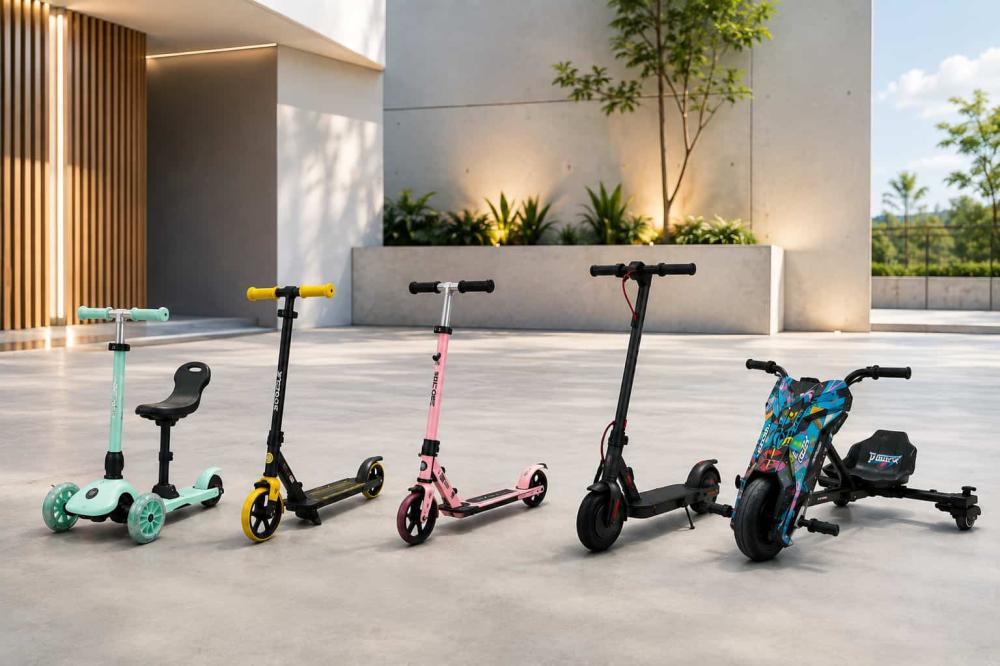
Scooter types are chosen from your home, not from the shelf. Five questions about your space and your floors will settle...
Before you open a single scooter page, walk four long strides across the space your child will ride in. If you finish them in a straight line you are looking at one type; if you finish them in a circle you are looking at a completely different one.
Scooter type comes out of your home, not off the shelf. Five questions about your space, your ground and your children settle it before you look at a single model.
Question one: what shape is your space
Space is not a number of square metres. It is a shape.
- A long narrow path or the pavement outside. A kick scooter serves this, because it wants a line to run along. Find them in three-wheel kick scooters.
- A square yard, even a small one. Drift works here, because it wants a circle rather than a line, and three metres of diameter is enough. Its place is the seated drift section.
- A flat with no yard. A light folding kick scooter, and nothing with a motor.
Measure with your feet rather than your eyes: four long strides give roughly three metres.
Question two: what ground will it run on
This question sometimes flips the decision entirely. Tile and smooth concrete suit every type. Sand and rough ground remove drift from the list completely, because its two rear casters need a smooth surface to slide on, and on rough ground they grip and nothing happens.
Uneven ground calls for a wider front wheel, a detail we publish on every model page.
Question three: how many children will use it
- One child. Buy to today's size without a large margin, because an adjustable bar gives you the extra years.
- Two children close in age. One scooter with a higher weight limit serves both in turn.
- Two children four or more years apart. Two different models in two similar colours. Colour solves the jealousy, size solves the riding.
Question four: which child is this
The most important point here, and the one nobody raises. A child who bores quickly abandons a kick scooter within two weeks because they have mastered it, and stays with a drift for months because no two turns come out the same.
The calm child who likes wandering slowly and exploring gets far more from a scooter they push themselves and can stop wherever they like, and is unsettled by a battery carrying them at a speed they did not choose.
Question five: how many years should it last
The weight limit answers this, not the printed age. Our kick scooters carry up to fifty kilos and our drift scooters reach sixty-five.
So a heavier nine-year-old can pass a kick scooter's limit long before passing its age range. Divide the price by the years you expect to get before you compare two tiers.
And what about standing electric
A fourth type where the child stands and a motor does the pushing. Closest in shape to a kick scooter and closest in feel to a drift, usually asked for by children past eight who want speed without a seat.
The full electric range sits in kids electric scooters, all of it at thirty-six volts with three speeds.
Three sub-types inside a single type
Even after settling the type, branches inside it change the experience:
- Folding or fixed. Folding means two seconds and a cupboard; fixed means a piece standing in the hallway. The difference matters in a flat and does not in a villa.
- Fixed or adjustable bar. Adjustment buys you extra years on the same scooter, and it is what parents most regret overlooking a year later.
- Fixed or removable seat. Some models work seated and standing both, which serves a child crossing between two stages within a year.
All three appear on every model page here, and we mention them to parents in store before they ask. The one with the longest reach is the adjustable bar, because it alone adds a year or two to the same scooter without you paying again.
What does not change between any of the types
The helmet. There is no difference between one type and another on this line, and its size comes from head circumference in centimetres rather than from the child's age or the kind of scooter they ride.
After that comes a lock if the scooter lives in a hallway or outside a school, and a front bag if the rides run long. Both are small lines forgotten at purchase and asked for a week later.
A quick decision table from Baby Story
- Flat · small child · smooth ground → a light folding kick scooter.
- Square yard · child over six · bores quickly → seated drift.
- Open space · child over eight · wants speed → electric.
- Child under three → not yet, and start at the tricycle.
The most repeated mistake in choosing a type
Choosing the type from the child's wish rather than the home's situation. A child sees a drift scooter in a clip and asks for it, the home is a flat with no yard, the scooter arrives, finds no room to turn, and gets parked within a week.
The fix is simple: settle the type from the five questions, then show your child what remains. Children accept boundaries set before they choose and resist boundaries that arrive after.
What we do with you in Baby Story branches
We ask you these five questions before showing you a single model, then narrow it to two and leave the shape to your child. That split works every time: you settle the type and the size, they settle the look.
The full range sits in the Baby Story scooter section, with a helmet sized by head circumference from the helmet section, and a lock and bag from scooter accessories.


